So Many Times I’m Almost In Tune

I get stage fright. Then I get even with me.

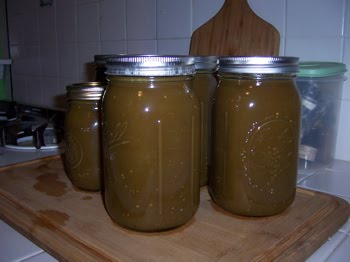
A funny thing happened on the way to jarring tomatillo sauce: I succeeded. Yeah, I don’t know how that happened. Except it was all pretty simple: Sunday, I bought a metric assload of tomatillos, peeled off the sticky papery peely thing and tossed them into bowls of water. After the tomatillos quit being sticky, I quartered them and dropped them into a giant stockpot, where tomatillos turned into tart green goo. Today, I re-heated the goo, burr-whisked it, pushed it through a strainer to remove seeds, which sounds labor intensive but that’s silly because I’m very lazy. Anyway, jars boiled, then I filled them with tasty goo and boiled them some more. Now they are sauce!

And, crap, I totally ran circles around the person who wasn’t sure she could do it.

Get Up Off Your Knees

Lovely Drusy. Every which way is up.

Tomorrow, cross your fingers: I want to make and jar tomatillo sauce. Last year, Pete and I made tart and refreshing tomatillo sauce as the basis for bloody mary mix, but we never made drinks with it. Instead, we tossed pasta in it, broiled fish with it and generally ran out of tomatillo sauce before we ran out of ingredients with which to combine it. Also: the last jar was better than the first, so we decided the sauce improved after about four months in the jar. Since we have no sauce on the shelf now, and if I jar tomorrow, by February, we will have outrageous green sauce, and I really, really want that. Really, really.

Blood Is On The Table

To continue Wednesday’s mile-wide rampage: Lou Dobbs can fucking bite me.

On Monday night, Lou Dobbs did a segment on how “Meatless Monday” is being adopted by the Baltimore city school district in an effort to cut costs and get children to eat healthier food. The segment showed schoolchildren eating vegetarian chili and grilled cheese sandwiches, and CNN reported that they found no parents who objected to the policy.

The news network also noted opposition to the one-day-a-week of vegetarian food by the American Meat Institute – a trade group that represents meat processors and packers with obvious financial interests in meat consumption. Without pointing out factors that helped fuel the initiative, such as childhood obesity and a national school budget crisis, CNN reported that the AMI is concerned that “students are being served up an unhealthy dose of indoctrination.” The institute’s Janet Reilly claims the policy was depriving students and parents of “choice.”

After watching the segment, Dobbs described this as “a real political storm in the making.” Um. Really?

Embedded video from CNN Video

Yesterday, I explained to the dumb fucker writing in the New York Times, for crying out loud, that his article made no sense. He insisted it did. I told him I’d sent that article to ten smart, interesting people, asking, “What is this guy’s point?” Most of them wrote back to say they had no idea. The writer then said his OpEd was intended to be tongue in cheek, his facts were correct and the editor did a slash job on his prose so his point was garbled. I told him that part of basic composition is to learn the difference between what you think you wrote and what you actually wrote. On the page. See? We then told each other to fuck off in colorful terms. It was brilliant, really. When he tries, he really can compose a sentence!

Part of our problem when we discuss poverty, nutrition, obesity, health care, insurance, reform of any kind, politics – anything, really – is that we are working in the medium of language. We do not agree what words mean. Good example: I said he is a bad writer whose work will hurt people. He thought I was saying I was a crazy person who found his email address and pressed the send button. It’s a mistake anyone could make. It’s not entirely his fault. We were using words and a lot of people, even smart people, don’t know what words mean or what they’re saying.

Example: if someone says to me, “We need to get more people on insurance and the problem will be solved” I hear ordinary words married to deceptive ideas, producing an argument that doesn’t hold water. It’s pretty simple if you’re actually listening. Let’s count off the problems:

* No one needs insurance. Everyone needs health care.
* The agent that needs more people on insurance is the insurance industry.
* The problem, in the case of that speaker, is not how does America solve its health care problem; no, the problem is how does the insurance industry increase its profits.
* The pronoun We is used to create a tribal identity that includes the speaker and the listener where no bond may exist, certainly not a shared need.
* That people who are not insurance industry flacks repeat statements like this is a function of successful advertising and public relations.

Statements like the above quoted signal that I am talking to a person who is not thinking about the topic anymore. His thoughts have been codified for him by an outside source. This person has gone to sleep. He probably does not know that; it is a waste of time to talk with him. That’s a lot to learn from one sentence. Imagine if we listened all the time?

Back to Lou Dobbs, who can still fucking bite me: presenting the American Meat Institute as an aggrieved party is HILARIOUS. Asking if anyone in this country talks straight anymore is a spittake waiting to happen. And tossing off that little lie that most children don’t get enough protein is a deft touch. Most Americans get more protein than their bodies need – so says the American Heart Association, but maybe Lou thinks the AHA is a bunch of pinko slackers. Babycenter.com’s research nutritionist Debby Demory-Luce says if your child refuses meat altogether, don’t have a cow.

The only time I worry about protein intake is when a child is on a restrictive vegan diet without dairy or eggs. If your child follows such a diet, either by your choice or because of his own food whims, you may want to consult with a registered dietitian who can help you devise ways to make sure your child gets enough protein from alternate sources.

The truth is that most Americans get twice as much protein as they need.

There’s nothing even the tiniest bit controversial about going meatless one day a week. There ought to be a very heated discussion, however, on the subject of Lou Dobbs.

And They Will Lean That Way Forever

You can ask ten people what the hell something means and you’ll get ten versions of I Don’t Have A Fucking Clue:

The Fat and Short of It

I’m feeling more Poirot than Clousseau. Tape on your detective mustache. We’re going in.

At nearly 6 feet 2 inches and about 175 pounds, Barack Obama may be the slimmest president since the Civil War. His body-mass index hovers near 23, well within the healthy range and somewhat to the left on the bell curve of American bodies. Perhaps he has some credibility, then, when he encourages the rest of us to shed a few pounds. During the presidential campaign, Obama suggested that rolling back obesity rates would save a trillion dollars for Medicare.

This is just the first of fourteen paragraphs of amateurish logicating and thinkerizing. I bet he wrote this drunk.

He’s right that there is a connection between excess fat and public health. Obesity is associated with a higher risk of cancer, diabetes, cardiovascular disease and other problems. If we could somehow slenderize the fattest people in America all at once, we would prevent an estimated 112,000 deaths a year, according to the Centers for Disease Control and Prevention. But girth shouldn’t be the only dimension in the health care debate. There’s at least one more bodily attribute that’s eating away at the Medicare budget: shortness.

Once again: 100% of people drop dead eventually. If you live 130 years, you will still go tits up and your life insurance company, far from being sorry, will still laugh all the way to the bank. Sucker! You lived 130 years! Your premiums sent executives’ kids to Yale!

We’ve long known that stature can serve as a crude measure of public health. If everyone came from a perfect home, the average height across the population would be a function of our genes alone. (There would still be tall people and short people, but we would all have grown as much as we possibly could.) Anything less than an ideal standard of living, though, tends to stunt a child’s growth.

Aha. Author Daniel Engber took a connecting flight to a dumb destination: tall people = healthy, short people = expensive loads. Sort of:

Many problems associated with being overweight correspond to being “underheight.” The shorter you are in America, the more likely your chances to develop coronary heart disease, diabetes or stroke. Fat people and short people lead briefer lives, and they put an increased burden on the health care system. Economists estimate that excess weight alone accounts for 9 percent of the country’s medical spending. There’s no such figure for insufficient height, but we do know that obesity and shortness play out in similar ways across the socioeconomic landscape.

Underheight? I’m fucking exhausted from these logical leaps. Not a shred of evidence, but a metric assload of innuendo.

In the labor market, the effects of height and weight tend to run in parallel. A 2004 study by John Cawley of Cornell University found that severely obese white women who weigh more than two standard deviations above average — women who weigh, for example, more than 212 pounds if they’re 5 feet 4 inches tall — are paid up to 9 percent less for their work. Likewise, a decrease in a man’s height to the 25th percentile from the 75th — roughly to 5 feet 8 inches from 6 feet— is associated with, on average, a dip in earnings of 6 to 10 percent.

One study? One? I could find one study suggesting we’re actually characters in a failed Vonnegut novel.

And like obese people, short people are less likely to finish college than those of average weight. A paper from the July issue of the journal Economics and Human Biology used survey data from more than 450,000 adults to conclude that male college graduates are, on average, more than an inch taller than men who never finished high school.

I bet they’re whiter and upper middle-classier, too. Call it a hunch.

Moreover, just as a buildup of abdominal fat increases the risk of chronic illness, so can short stature have a direct impact on physiology. Smaller people, for example, have smaller lungs — and reduced lung capacity is a risk factor for death from cardiovascular disease. Shorter people also have narrower coronary arteries, which may be more susceptible to atherosclerosis.

I guarantee you no one looks at me and thinks about reduced lung capacity.

Whatever the cause, higher weight and lower height are associated with chronic disease, low wages and poor educational attainment. And while we are getting fatter, we may be getting shorter too. The economist John Komlos has shown that the United States is losing height relative to other developed nations, and some American demographic groups are even shrinking in absolute terms. Yet we tend to discount shortness as a mere byproduct of genetics and early-life experience, while treating the obesity epidemic as if it were a grave danger to public health. Why can’t our campaign to reshape the American body have two fronts? If we really want to make our country healthier, let’s have a war on shortness too.

What the hell is this guy on about? Does he even know? And why do I want to mail him a toy gun and a card telling him his Declare A War On Whatever problem is absolutely not at all about a tiny penis?

You’re excused for scoffing. You probably think of weight as a problem we can fix, while height seems beyond our control. We could try to make people thin by taxing junk food or by raising their insurance premiums unless they go on a diet. But what kind of policy could make someone taller?

I’d thank him for his permission, but I’d scoff without it. By the way, we will come back to this paragraph soon, because:

Controlling our country’s height may be just as plausible — or implausible — as controlling its weight. It’s true that someone who is fat can lose weight on purpose, while a short adult can’t do anything to gain height. Yet instances of radical, lasting weight loss are exceedingly rare. Diet and exercise schemes tend to yield only minor effects over the long term. While lesser changes to your weight may be associated with modest health benefits, they won’t help all those obese adults to become slender. For most of us, changes in body size follow a long, slow pattern across our adult lives. Every year, we lose a tiny bit of height and gain a pound or two of weight until, in our older years, we shrink in both measurements.

So…we can’t really fix our obesity problem, or this height “problem” and we’re shrinking and gaining and WHAT IS THIS GUY TALKING ABOUT?

Given how hard it can be to lose weight, a realistic war on obesity starts to look a lot like a war on shortness. In both cases, we’re dealing with a complex function of genetics, social class and poor health in childhood.

Can’t we try height and weight diplomacy?

Early-life experiences play an important role in the development and consequences of body size. Exposure to malnutrition, infectious disease, chronic stress and poverty stunt a child’s development and seem to explain many of the long-term problems associated with short stature. Environmental factors may promote obesity, too: lack of breast-feeding, bad nutrition, chronic stress and poverty have all been associated with early weight gain and a higher risk of health problems down the road.

We veer so close to a real point – but no. This paragraph goes nowhere.

A range of sensible interventions could address both problems at once. To win a war on shortness, we might promote the consumption of fruits, vegetables and other foods that are low in calories and high in micronutrients. Or we could invest in education as a means of alleviating poverty and environmental stress. Better access to doctors for children and their parents would improve prenatal and postnatal care and stave off the stunting effects of childhood disease.

Education. [W]e might promote the consumption of fruits, vegetables and other foods. All right, let’s talk about that. The feds fund a program called WIC that is run by each state. This is the rather straight-forward website for New Jersey. Pennsylvania’s is ornate and condescending, and the charming Nutrition facts in the foods list is an especially stinky touch. You should have a look at your state’s WIC website and ask yourself this question: do people who can’t afford food have computers and net connections?

From the outside, these programs look like a reason for optimism. If so, you’ve never spent a day shuffled from desk to desk and line to line with endless demands for documentation, suspicion about your identity and disdain for your need for help. I applied to this program when I was starving. Apparently, I wasn’t starving enough, which was news to me. Anyway, WIC is perpetually underfunded. The checks are very small. The rules are very strict. I recently waited in a checkout line behind a customer using WIC checks for groceries and watched the lengthy checkout process with horror. It seemed designed to publicly shame and humiliate the customer. But hell, why not? That woman’s children are probably short. She’s got it coming!

None of these policies treat body size as an end in itself. We would never just prescribe growth hormones and bariatric surgery to every child who doesn’t fit a tall, slender mold. Obesity and shortness are society-wide measurements, not reflections of individual virtue or good health. To that end, our goal should be to improve the quality of life for children. If we can manage that, they just might end up a little taller — and thinner too.

One doesn’t have to be a fictional detective to notice that at no point did our author prove anything at all about health advantages of height. Nowhere. Nothing. He said smaller people are unhealthy and did not document it. His reference about shortness distinguishes between ordinary variations in size and a medical condition that needs treatment, but that distinction is lost on Engber, who seems more interested in economics than health anyway. Look, I have no credentials, but I can read. I asked a woman with some public health experience in Africa to read this article and offer an opinion. Her opinion was that Daniel Engber had no idea what he was talking about.

This is bothersome:

…we would all have grown as much as we possibly could.

If Engber were intellectually honest, he would come out and say that Americans have to suck it up, get over our terribly terrifying terror that someone, somewhere is getting more than he or she deserves – we’ll talk about that word deserves very soon – and get down to the business of properly feeding and caring for the people within our shores. No hissyfits about socialism. No hiding behind bullshit libertarian economics justifying selfishness and inequality. Children grow taller and stronger if they are properly fed and cared from even before birth, which requires money and resources; they will lead longer, healthier and more productive lives. Mostly. What Engber doesn’t have the balls to say is that if better public health is our priority we should collectively pay for it, enjoy it and shut up, and if taxing fast food and increasing insurance premiums is what we do instead, then we don’t actually give a shit about public health. No. We’re just scapegoating the short, the fat, the poor, the uninsured, the malnourished, the sick, the defenseless.

There’s more to talk about and I’ll get to it, but I’m going to have a glass of wine and calm down before this dumb fucker’s nonsense gives me an expensive aneurysm.
And Ask Many Questions Like

Panky and his parents came to our house for dinner Sunday night. Panky laps around the dining room while his parents held still and ate london broil, grilled peppers, sweet potato puree, broccoli florets, corn on the cob, apple pie, frozen yogurt and strawberry compote, and groaned that they were too full to move.

As humans go, Panky is large enough to make a giant mess but small enough to swing around and burble, “Vrooom.” It is a good size: almost big enough to be two, but still one. “But!” he says, “But!” I am still waiting for him to pick a name for me.

Dangled From A Rope Of Sand

Previously on Poor Impulse Control, I caught wind of a wild idea.

Come to think of it, I don’t remember seeing recycled products in the paper aisles. At least, I don’t remember recognizing specifically recycled products. I don’t use tissues because everything I own has sleeves – kidding! Paper towels work better for me and efficiently exfoliate the tender nostrils at the same time. Yes, I’m a brute. I use regular kitchen towels, sponges and mops most of the time but for what I use paper towels, I could switch to recycled. In fact, bring it on!

It was brung:

I switched to recycled toilet paper and while I didn’t love it, the idea of loving toilet paper is too much for my tiny mind. In an upscale grocery store near Mr. DBK’s house, I discovered more brands of recycled paper products than I knew existed, which seems promising. The switch to recycled paper towels went fabulously, which might sound like exaggeration except it also provided me with occasions to drag grocery store managers through anemic paper product aisles and demand better selections, which havoc you can wreak also wherever you shop. It’s a blast, and until everyone has a decent selection of recycled paper products in their grocery store, convenience store, drug store or bodega, you can pretty much bet on world-changing havoc and hilarity wherever you go. It’s a renewable resource, like solar energy and celebrity hijinx – though, since I don’t pay attention, about once a week I wonder when Britney Spears’ husband took up championship tennis.

And brung some more:

I was just about to declare my happiness with recycled paper towels when Karama Neal of So What Can I Do? suggested ditching paper towels entirely and going with cloth napkins. I don’t want to advocate anything without giving it a go myself, so after 10 August, I haven’t bought any paper towels of any kind. Let’s talk specifics.

1. What cloth napkins? Years ago, Auntie InExcelsisDeo gave me a hamper full of the ugliest ancestral cloth nakpins you’ve ever seen in your life and some that were just silly-looking, with the admonition that my beloved grandmother Edith would spin in her grave if I set fire to them. So I started out with a bale of cloth napkins I’d pretend I don’t know in public, which I tossed into the washer in my kitchen Sharkey describes as “the world’s largest bread machine.” I didn’t have to buy or make them. I had them – and they had me.

2. What do I use paper towels for? Other than emergency spills – for which paper towels are ill-suited – I use paper towels because I am allergic to only two things: oxygen and nitrogen, and I sneeze a lot. Tissues are flimsy, wasteful and useless. Handkerchiefs have always seemed disgusting. Are you kidding me? I blow my nose, fold my hanky and stuff it in my pocket – where I’m certain to stuff my hand eventually? That can’t be sanitary. On the other hand, my grandfather, whom I adore, has always carried a hanky. The old Cape Codders have always been very careful about their resources and creating garbage. I couldn’t deny it would be a sensible course of action, and I could diminish the Ick Factor by dropping used cloth napkins directly into the washer.

3. What do paper towels mean? We didn’t have paper towels when I was growing up. Rich people had paper towels and air conditioning. We didn’t have those. When I started thinking about the meaning of disposable stuff, the expense, the trees, the toxins, I couldn’t even argue with Me. Thus, clean cloth napkins sit in colorful piles all over my house.

That was a very good year for things going tragically wrong and hilariously right, so when I had dinner napkin-shaped hankies all over my swingin’ bachelor pad only I was chagrinned. I got used to tossing them into the washing machine and quit thinking about paper towels completely until kittens yakked on my kitchen floor. Kittens became cats, I moved house, we acquired another kitten and tenants; we’ve stuck to recycled paper products and cloth napkins. But a funny thing happened when I stopped thinking about what I was doing: I stopped thinking about what I was doing. The other night, I had one of those embarrassing revelations that make my life a rich pageant.

Tata: You know how we sit here during our undeniably fabulous dinners trying not to eat with our fingers because we wish to virtuously avoid using paper napkins?
Pete: I guess.
Tata: And you know I have piles of cloth napkins still boxed up from one of Dad’s restaurants?
Pete: That I know, yes.
Tata: Well, it finally fucking occurred to me we could use then as dinner napkins.

I’m a slow learner.

No Matter Who You Are Shining Bright

This fresh hell is the oldest trick in the book.

North Carolina is poised to become only the second state to impose a fat fee on its state employees by placing them in a more expensive health insurance plan if they’re obese. Smokers will feel the drag of higher costs, too, as North Carolina state employees who use tobacco are slated to pay more for health insurance next year.

North Carolina officials, coping with a steady uptick in health care costs for state employees each year, are aiming to improve state workers’ health, which saves money in future medical expenses.

“Tobacco use and poor nutrition and inactivity are the leading causes of preventable deaths in our state,” said Anne Rogers, director of integrated health management with the N.C. State Employees Health Plan. “We need a healthy work force in this state. We’re trying to encourage individuals to adopt healthy lifestyles.”

No, you’re punishing fatty fat fatties and bad kids. In point of fact, 100% of state employees will suffer death. If Ms. Rogers were a little smarter, she’d realize these demographic groups are – nyuk! nyuk! nyuk! – cash cows as far as the pension system is concerned. No retirees? Ka-ching!

State workers who don’t cut out the Marlboros and Big Macs will end up paying more for health insurance. Tobacco users get placed in a more expensive insurance plan starting next July and, for those who qualify as obese, in July 2011.

Nope, nope. Still going to die. The insurance company is probably a wholly owned subsidiary of Phillip Morris and McDonald’s. Sure, there’ll be a few surgeries to underwrite, some chemo and prolonged hospital stays, but since insurance companies have an almost magical ability to profit if customers live or die, why not hand out cartons of unfiltered cigs and coupons for Quarter Pounders and stack the deck? Come on, Big Insurance! Let’s get it the fuck ON.

Some state employees, though, are criticizing the planned changes. The State Employees Association of North Carolina opposes the tobacco and obesity differentials as invasive steps that could have been avoided if the legislature had fixed the plan.

“It’s my understanding they’re talking about testing (for tobacco use) in the workplace which, to me, would create a hostile environment,” said Kim Martin, a sergeant at Piedmont Correctional Institution in Salisbury. “And it’s an invasion of privacy. This is America, the land of the free. I don’t think (body mass index is) a very good measure. I know some folks who would have a high body mass index because they’re muscular.”

Body Mass Index is actually a very crappy measure because it assumes everyone has the same bone structure, same muscle density, same genetics, same diet, same habits. None of that is true. It’s even a lie that drugs treat everyone. Hey, I liked Seldane but it apparently killed people who weren’t me. Woohoo! Lucky me! Well, except that I can’t have the only allergy medicine that ever worked for me because a few lightweights clutched their chests and keeled the hell over. Weaklings. Anyway, about the BMI: here’s your calculator. Hold onto that thought, we’re going to come back to it.

The idea of penalizing unhealthy lifestyles and rewarding healthy conduct is hardly new among insurance plans. Public health insurance plans in other states already penalize smokers or reward nonsmokers in insurance costs. South Carolina’s state employees health plan is scheduled to add a $25-per-month surcharge on smokers in January. Elsewhere in the southeast, Kentucky and Georgia impose surcharges, and Alabama gives non-smokers a discount.

Alabama was out front on weight testing. Starting in January, state workers will have their blood pressure, cholesterol, glucose and body mass index checked by a nurse. If they’re in a risk category, such as a body mass index of 35 or greater or a blood pressure of 160/100 or greater, they are charged an extra $25 per month on their insurance premium. If they go to a health screening, either offered by the state or by their personal physician, then the $25 is subtracted, according to Gary Matthews, chief operating officer for the Alabama State Employees Insurance Board.

North Carolina will allow state workers with a BMI of up to 40 to keep the discount, although a BMI of 30 is considered obese by some experts.

Fat people know they’re fat. There’s absolutely no need to consult an expert. Further: that health screening thing. What is that? You go sit in a trailer parked outside your facility. Someone takes your blood pressure, tells you you’re fat and takes $25 off your insurance premium? What does that even mean?

Only a fraction of employers, though, offer financial incentives for healthy behavior or wellness programs, such as gym memberships or smoking cessation, according to a Kaiser Family Foundation study last year. Differences in employees’ education, health literacy and access to basic health care could affect the usefulness of financial incentives in reducing health care costs over time, the study said.

The results are not yet in. The higher costs for smokers and the obese don’t appear to have been in place long enough for any state to boast of a healthier work force yet, according to officials in several states.

“I don’t know that any states have a lot of hard data on this,” Rogers said.

And none will because punishing fat people and smokers is not intended to improve anyone’s health. It is intended to divide clients into groups that will resent one another and to divert attention from the deeper truth: if we had a national health system, none of this would be necessary. If health care were the point, we would not be seeing divide and conquer. The point is that profit is most easily made when our common interests are obscured.

So let’s go back to the BMI, which is as bogus a metric as it gets. We’ll use me as a handy example of how this thing fails. Okay? Okay. My weight fluctuates within a ten pound range, but at the moment, my BMI is 28.9. By this standard, I am overweight. Sure, I’d like to lose a few pounds but they won’t stay off because I’m a 46 year old woman. I exercise every day. In the last year, I’ve skipped a total of eight days. I eat two meals a day, drink lots of water, bicycle to work in good weather, eat a diet that would make nutritionists turn cartwheels, and take very good care of myself. I drink wine. So sue me. Anyway, none of that is important because 28.9, bitchez!

At the time this picture of me was taken, I was probably 16. I did 250 pushups a day and just about the same number of situps. I had and used my own chinning bar. In fact, I had and used one until I was just about 40. In this picture, you can clearly see that I was well-toned and in good shape, but not thin. Insurance charts said that someone of my diminutive stature should weigh 105-108 pounds. Even anorexic, I could never get below 119, and it was a struggle to stay close to 125. As Siobhan says when I mention my weight, “What, are you made of mercury?”

So here I am: a prime example of the BMI’s shortcomings. So how do we measure health? How about we stop doing that to punish each other? How about we offer everyone health care, offer people dental care? Stop whining that someone undeserving might get something they don’t desertivity deserve and concentrate on how it would change our own lives if we didn’t have to worry anymore, and if the people around us didn’t have to worry anymore, and if everyone had the resources to take care of him/herself? EVERYONE would be sick less often. EVERYONE could care for children and aging parents properly. EVERYONE would not have to face bankruptcy over medical bills. EVERYONE would have a better life. Even you. Especially you.

Crossposted at Brilliant@Breakfast.