With A Deck Of Fifty-One

I’ve butted into your business before and I will do it again, but this has to be said: make your own damn yogurt!

Recently, 8 ounce wide mouth Ball Jars changed my ultra-glamorous life. The glass jars that came with my ancestral yogurt makers have become delicate with age and I’d prefer not to take them to work. One day, I was foraging in my vast stores of Stuff Dad Gave Me and discovered the 8 ounce wide mouth Ball Jars. They fit perfectly into one of the ancestral yogurt makers and they don’t break when Topaz pushes one off the kitchen counter. You don’t have Topaz reorganizing your glassware, but the Ball Jars might help you carry that yogurt you’re making to work with you.

Lovely Drusy cannot sniff you without playing kissy face.

Miss Sasha calls and asks questions. Is Jell-O gluten-free? This morning, one of my co-workers stepped into my cubicle and said, “You are a genius, I think. Has anyone ever said that to you before?” A couple of months ago, I was walking to the bank when a woman across the street waved and shouted to me in a peppery mix of Russian and English. From a distance she looked like Auntie InExcelsisDeo, who does not speak Russian and though she speaks no other language avoids speaking English if she doesn’t have to, so I approached with a smile and realized we did not know one another. By the time I put my hand on her forearm, she had called me a genius and by someone else’s name. I said, “Hello, but I am not her.” She said, “I thought you were my niece!” I said, “I thought you were my aunt!” Then I laughed all the way to the bank and checked the name in my underwear – and I was only sure I was me when I wasn’t wearing any. Memory can be overrated but being able to work out a problem is good stuff, so I told Miss Sasha to call the phone number on the box and ask a direct question.

In fact, my co-workers ask me questions all day long.

Beth: Can I ask you a question? I was just cleaning off my desk and I moved something and do you know what size mouse droppings are? Have you ever seen them? Are they small or big? We were having a mouse problem awhile ago, I remember, and I was just wondering –

Hmm. That doesn’t do this justice. Imagine Beth, who is a gentle, lovely person, talking without taking a breath.

Beth: CanIaskyouaquestion? IwasjustcleaningoffmydeskandImovedsomethinganddoyouknowwhatsizemousedroppingsare? Haveyoueverseenthem? Aretheysmallorbig? Wewerehavingamouseproblemawhileago,Iremember,andIwasjustwondering –

Tata: You saw mouse poop and thought of me?

Beth: [Can’t breathe for laughing.]

Tata: Go talk to Hal. He’s lived on farms all his life.

Maybe it’s the decades of working in a library, but I’m convinced that whatever the question, someone – somewhere – has the right answer. It’s probably not me, but someone. For instance, someone knows why this bullshit health insurance debacle has gone so horribly wrong and I am afraid it might be Dr. Marcia Angell.

Don’t Be Blind To the Big

We interrupt this blog to point out that playing with your food is funny. For me. If I were you, I’d be dialing the pizza place right now.

Miss Sasha, my sweet:

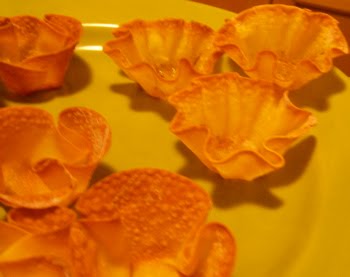
A couple weeks ago, we were talking about edible cupcake papers and I brought up egg roll wrappers. You are probably right that spring roll wrappers, properly prepared, are the kind of textural nightmare dessert enthusiasts might find disconcerting, but I haven’t given up hope. In the meantime, I bought a $1.49 stack of dumpling skins, dug out the mini muffin tins and persuaded the cats to take a powder.

1. Spritz pans with release.
2. Fit dumpling skin into muffin well thingy.
3. Spritz dumpling skin.

Bake at 350 for 8-10 minutes, depending on how half-assed your oven is. They came out of the oven crisp and golden brown. The second time:

4. Sprinkle on cinnamon and sugar. Lightly. I mean that.

Dude, these things are tasty, crunchy, subtle and you immediately shout about things you will be stuffing these cups with, should you stop what you’re doing and make more. Which you will.

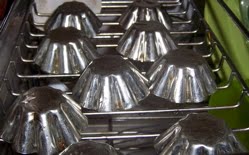
So I was foraging in the basement for the regular size muffin tin when I came across a bag of my dad’s mini fluted pastry forms. After a good soak, the forms still look like murder weapons. That’s how you can tell they were well used, not that we’ll ever know on whom.

The dumpling skins fit beautifully into the forms but you have fit the skins with a firm hand. Once baked, they slip from the form or pan without any effort on your part, yay!

Baked dumpling skins are pretty. You can flavor them with anything. I wouldn’t try serving anything wet in these shells – or any shells, for that matter – but Pete promised me smoked trout salad with goat cheese and chives. Naturally, I will make the great sacrifice of eating that. You know. For science.

My sweet, if you think you could use the fluted forms, you can have them. Let me know what you think.

Knishes,
Mom

Put ‘Em Under Pressure And You Watch

So I’m – like – frigging civic minded. Last month, I went to a well-attended meeting about sustainability and didn’t punch anyone in the face, though the topic did come up. Last week, I went to a second and – fortunately for me – the face I wanted to punch didn’t put in an appearance and a mustachioed man at the other end of the table became visibly excited every time I blurted something blunt and sensible. Perhaps he was happy that someone else was interested in tasks and not subcommittees; it’s also possible he was tired and my peppery language burned a bit. Anyway, his bouncing was no doubt aerobic: I made many remarks that ended with a growled, “…why the hell not?”

It wasn’t a question. I’m colorful like that!

A member of the committee said the tiny town was interested in setting up a recipe exchange.

Tata: Go one better: make the recipes feed a family of four for $10.
Committee Member: Is that even possible?
Tata: Of course it is.
Another Committee Member: With actual food?
Tata: I double dog dare you.

Yes! I did it! I double dog dared the committee to try something tougher than talking, party throwing and meeting attending-ing. Fortunately, other people are working on this very proposition.

USA TODAY asked four dietitians who blog at dietchallenge.usatoday.com to come up with creative ways to feed a family of four for under $10 — as healthful alternatives to the meal advertised on a new KFC commercial. The company is selling seven pieces of fried chicken, four biscuits and a large side, such as mashed potatoes, for $9.99 and is challenging people to make this meal without going over that amount.

This inspiration SUCKS. Is there good news?

Cooking a meal for a family of four for under 10 bucks is a piece of cake. You can make hearty soups, sub sandwiches, chicken dishes, Sloppy Joes, large salads with leftovers, omelets and other egg dishes, nutritionists say.

USA TODAY is not the only entity interested in the challenge, but some responses are more awesome than others.

You’re saying to yourself, “No sweat, I can make you six months of recipes with one ladle tied behind my back.” Yeah, but you have to do better than a plate and a block of cheddar. That’s the caveat: that dinner for four for less than $10 must be nutritious. Don’t be shy.

Speak up. I double dog dare you.

She Gets It While She Can

How To Use A Potato Bin

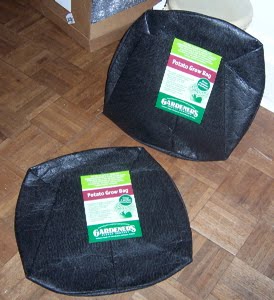
Potato bins and grow bags are used to grow the earliest potatoes. They are also used along with raised beds to grow prize winning potatoes for the garden show bench.

Potato bins, bags, and potato barrels fit on any hard surface or small piece of ground open to full light. Try them on your patio or balcony. They give you a convenient way to harvest fresh spuds.

Here you’ll discover how you can grow the earliest potatoes for summer salads and the latest ‘new’ potatoes to eat fresh and roasted for Christmas dinner.

They might be easy to grow.

POTATOES ARE EASY TO GROW VEGETABLES

I feel better already.

SELECTING POTATOES – make certain that you choose only certified seed potatoes for planting in the garden. Certification means the potatoes are free of insect or disease problems and that they have not been treated with a growth retardant. Garden centers; nurseries; garden outlets and hardware stores generally feature certified seed potatoes during the spring planting season.

SOIL PREPARATION – potatoes grow in just average soil, so a great deal of soil preparation is not really needed. However the addition of some compost or a little peat moss is beneficial. Avoid using fresh manure or lime in the soil where potatoes are to be grown, as it tends to cause scab on the potatoes. The addition of either 5-10-10 or 10-20-20 fertilizer is beneficial. Mix the fertilizer into the planting soil, prior to planting. Till or spade the soil to a depth of ten or twelve inches.

CUTTING POTATOES – if the seed potatoes are small to medium sized, plant the whole potato. If they are large sized, you can cut them in half, or quarter them. Each section should have two or three ‘growth eyes’. After cutting, let the cut surface callus-over before planting them.

SPACING – potatoes can be grown in many different ways. If you have lots of room the cut pieces can be spaced about a foot apart in rows which are spaced two to three feet apart. Then cover with about an inch of soil. Pull in additional soil as the plants develop. Always be certain the surface tubers are covered with soil.

Hilling or mounding is another method of growing potatoes. Three or four pieces of potatoes are planted on a mound of soil, pulling in additional soil as the potatoes develop.

You can grow potatoes in the ground, in stacks of straw or mulch, in black plastic bags, in garbage cans or to stacks of tires. Potatoes can be a fun and easy crop to grow.

Field growing: This is the conventional way most potatoes are grown. Generally, the seed potatoes are planted about 12 inches apart in rows that are spaced 2 to 3 feet apart. The seed pieces’ are planted about 1 inch deep, then covered with additional soil as the sprouts develop.

Straw: For centuries, Scandinavians have grown potatoes in stacks of straw or other mulching material. Potatoes are planted above ground in the straw, and as the vines begin to grow, additional straw` or mulch is mounded up around the base of the plants. This results in a yield of very clean potatoes. New potatoes can be harvested easily even before the potato vines mature completely.

Under plastic or in plastic garbage bags: Garden soil or a commercial potting soil can be used to grow the potatoes in the bags, Fold over the top half of the bag, fill with soil, and plant a certified seed potato that has been cut in half. The plastic bag can be set above ground wherever it’s convenient. Punch holes in the bottom of the bag for drainage.

You also can plant potatoes under black plastic. Cut open a piece of the black plastic, and plant a potato piece. The potato tubers will develop as they would in the open ground. However, the tubers that develop close to the surface of the soil are shaded by the black plastic and should not develop the green inedible portions that often are found on other tubers. The black plastic also will aid in controlling weeds.

Garbage cans or containers: Old garbage cans, or wooden or fiberboard-type containers are suitable for growing potatoes, if they have adequate drainage. You can conserve space by growing them in this manner. A word of caution, though: The plants tend to dry out more rapidly when grown in containers, so additional watering will be needed. Otherwise, you’re likely to end up with misshapen tubers.

WATERING – Black or hollow centers on potatoes is often caused by over-watering. Irregular watering causes irregular shaped or knobby potatoes. As a guideline, water potatoes (thoroughly) weekly during warmer summer weather.

HARVESTING – New young potatoes are harvested when peas are ripe or as the potato plants begin to flower. For storage of full sized potatoes harvest them when the vines turn yellow or have died-back.

STORAGE – Keep them in the dark, in a spot where temperatures are about 40 degrees.

I’m giving it a whirl. You might give it some thought.

You Always Were Two Steps Ahead

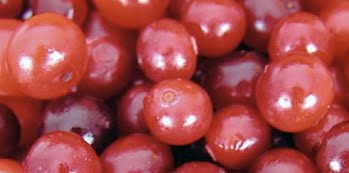
Miss Sasha let slip that in North Dakota she can get fresh lingonberries, long a staple of Swedish food. Here in New Jersey, lingonberries are generally only available after a lengthy traipse through IKEA, though recently, Pete and I found them canned in the grocery store. Thus, I have informed Miss Sasha she will be jarring lingonberries because I want to eat those, and isn’t that what’s important in life? Sure. So let’s talk about banana bread. I started with a recipe from a famous cookbook, which was okay but not great. Gradually, I made it healthier, moister real food. I’d pat myself on the back but – would you get that for me?

Preheat oven to 350 degrees. In a large bowl, whisk together dry ingredients:

1-1/3 c whole wheat flour
3/4 teaspoon salt
1/2 teaspoon baking soda
1/4 teaspoon baking powder

Optional

1 tablespoon basil
1 teaspoon ground ginger
1/2 teaspoon allspice
1 teaspoon cinnamon

In a separate mixing bowl, cream together:

5 generous tablespoons butter
2/3 c brown sugar

Slowly add dry ingredients, then add:

2 lightly beaten eggs

Fold in:

1/2 cup dried cranberries
1/2 cup chopped walnuts or toasted pignoli nuts
5 mashed bananas

Grease a loaf pan and dump in the gloppy batter. Bake 50 minutes. Test for doneness with a butter knife. If batter sticks, bake and test in five minute increments. When finished, the bake will be moist and very dense. Serve slices toasted with cream cheese.

Banana bread is often a way to use leftovers, but I think it’s a simple way to get more fruit into our diets in the winter. Tonight, I made a whole cranberry bread based on the same recipe, adding some minced tropical I’d bought dried and reconstituted plus a little orange juice. The flavor is sweet and tangy; Pete is looking forward to eating a couple of slices toasted with butter for breakfast.

The thought occurs that super ripe platanos could substitute for bananas. Think I’ll try that. And you?

Collar To the Cold

Here at Poor Impulse Control, we’re all about It, whatever It is, so long as It is funny, and nothing is funnier than talking about food. Why? Because I get stage fright making rice pudding and half my family went to cooking school without so much as sending a postcard. To recap somewhat, then, I have several different projects going and your bag’s packed.

1. Dad died and left cookbooks to study, mysterious gear and problems to solve;

2. Dagnabbit: jarring, canning and preserving;

3. Inspired by Pete’s wonky digestive tract, he and I are exploring better food for better health including organics, reducing meat consumption and expanding our vegetable and grain options;

4. Gardening. It’s better to grow one’s own food than to rely on outside sources wherever possible;

5. Affordable, nutritious eating. If we can get dinner on the table every night for $10, we might have enough money to pay our fucking bills.

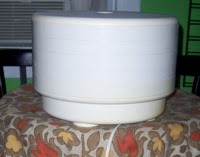
These topics overlap somewhat. For instance: remember our friend, Dad’s dehydrator? Instructions for the mothership here are hard to come by in book form and online recipes are full of slippery adjustments. Example: every direction I found ended with store in a cool, dry place and last summer, New Jersey did not provide any of those; in time, everything I dehydrated and stored in the basement turned a lovely blue. Pete and I picked up a vacuum sealer, thereafter sealed everything and stored it in the fridge. This degree of caution still did not guarantee success: sometimes dehydrated vegetables are sharp and pierce the plastic and appear sealed anyhow. They are not and will turn a lovely blue in the fridge, which like the rest of New Jersey is slightly damp.

Ta, dahhhhhlink, you’re saying, Can we take a connecting flight to the point? How about you return your tray to the upright and locked position and not be so critical, hmm? As lessons in home economics go, learning dehydrating without a teacher proved tricky, expensive and frustrating. In practice, dehydrating works best for us with fruit like peaches, pears and apples. Reconstituted, these sturdy fruit add nice flavor and the texture is familiar if you, as I did, grew up eating dried apples; I also learned the hard way that peeling apples and pears before drying is worth it. A second preparation has been very successful: combinations of leeks, young carrots and fennel – loosely speaking, a form of mirepois. Rehydrated and minced, one of these packages adds a jolt of kickass richness to soups, stews and sauces.

The next thing I wanted to road test was fingerling potatoes. I know. No, really. I know. You can buy potatoes all year round, there’s no point in drying them, right? There is, actually. I bought these potatoes from local organic farmers with excellent tattoos. When I bought them in September, I parboiled them, sliced them lengthwise and dehydrated them overnight at the highest setting on the dehydrator: 175 degrees. Two nights ago, I opened the package and poured boiling water over the potatoes, and when they cooled, I refrigerated them until this morning, when I drained off the water, mixed in about a cup and a half of homemade yogurt, half a cup of grated cheddar, salt, pepper, cumin, dried sage and minced rosemary. I poured this into two small casseroles, dotted the surfaces with a bit of butter, covered with foil and baked at 425 for an aromatic eternity. For the last fifteen minutes, the potatoes baked with foil off to develop a nice crust. Result: a filling breakfast gratin that tasted like summer.

Pete was hesitant before the first bite but enthusiastic thereafter. He offered that the potato flavor was good but next time, instead of long rehydration, we might try boiling the potatoes. It will save time. We decided that in the future we wouldn’t dehydrate other kinds of potatoes, just fingerlings, and the initial storage failures, while discouraging, had taught us enough to be worth the price.

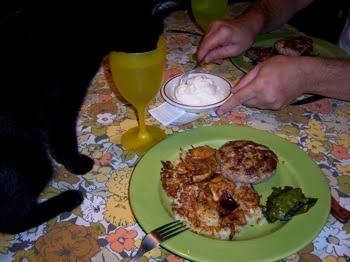
This is a picture of dinner at our house: Pete makes something almost miraculously delicious, I make a yogurt or a fruit sauce, and Drusy drinks water out of a plastic goblet. We have all accepted that at dinnertime, Drusy will be joining us for drinks. Believe me, this is a civilized alternative to what might have become our routine had the other two cats decided they wanted to fight us for our dinners. Pete and I are okay, though, until one of the cats learns how to operate a spatula.

Like the Deadly Hands Of the Radium Clock

Tata: Is Lois there and is she good and surly?
Anya: Lois, are you good and surly?
Lois: Who is it?
Anya: Auntie Ta. Get over here!
Lois: Hello?
Tata: I have all the ingredients for tempeh dumplings laid out on the counter. Wanna come over and teach me how to make them, since you’ve made dumplings and I haven’t?
Lois: I can’t. I’m going out to play in the snow with my friends.
Tata: I don’t blame you. That sounds like more fun than calling Poison Control.
Lois: Sorry about that.
Tata: Talk to you later when you visit me in the hospital!

Since I was in my house and happy, I thought I’d try out something new. We had wonton wrappers because this day was going to come eventually, vegetables because I was betting on the snowstorm and tempeh because why the hell not? I cooked everything that needed cooking, drained everything and minced the whole mishegas. So I brushed each wrapper with water, filled it, pinched it closed and laid each little dumpling on parchment paper. It was a lot like working with phyllo dough in that the wrappers dried out quickly, but it was also very satisfying to fill up trays and freeze them. Vegetable dumplings are my favorite breakfast. I’m psyched!

Let’s Discuss This Man To Man

We’re expecting a snowstorm tomorrow, which means that my neighbors and co-workers are still slathered in minty BenGay from the last one. I can’t wait! By lunchtime tomorrow, every eye in my office will glance furtively at the tiny windows through which we in the basement observe weather and feet walking by. By mid-afternoon no one will compose a sentence that does not involve the word snow. By rush hour, the peaceable folk will beating each other senseless over bread and milk because grocery shopping before the Super Bowl was two more thoughts than any mind can hold – or so weather forecasters suggest. Don’t listen to them! You’re prepared and ready to roll out or stay in, whichever plan your brainy brain brain conjures up. Make tomorrow’s dinner tonight, dress in layers and watch out for your elderly neighbors. It’s all in your hands, cozy in fuzzy mittens.

When A Flaming Stealth Banana Split the Sky

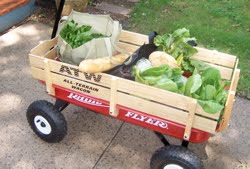
A few years ago, my friend Trout had a CSA share with the unnamed university’s agricultural extension’s wacky farmer training program. The whole idea was new to me when she called one Friday from a business trip to ask if I could go pick up her weekly share. I drove out to the farm, rumbled across the PVC cow catcher and crept along the farm road about a half mile past a house and a sign threatening visitors with dire consequences if one of the resident children or varmints had an accident to the outbuildings in the back. In a small, awkward parking lot, I beached my car when it became completely obvious that 130 sharers were planning their weekly rumble over a two-hour window for pickup and 12 parking spaces; good thing we’re all peaceful and organic!

Inside, agricultural students had brought in vegetables, herbs, gourds and decorative plants, counted each and divided by the number of shareholders to formulate a list of what each shareholder should collect. This part of the process was really mysterious at first as I shuffled between ancient supermarket refrigerator bins, trying to figure out what the hell I was looking at and whether or not I recognized it as food. One aspect of the CSA experience is education: the aggies learn how to grow a wide variety of plants and shareholders learn how to prepare tasty stuff they’ve never heard of. It works great. In fact, it works so well that a couple of years ago, my sister Daria shared a share with Trout and learned to like, then love, sorrel. Daria’s sorrel problem was so bad she found herself staring into her reusable treehugger grocery bag, shouting, “WHERE THE FUCK IS MY SORREL?”

(Note: though Daria would rather chew off her French manicure than touch dirt I’m planting sorrel for her in a planter sorrel will like and her homeowners’ association will surely disparage. I would bet my shoes the association has not seen anything like full-metal Daria on a sorrel-inspired rampage, and I will laugh and laugh. And have bail money.)

CSA shares aren’t cheap. We’re looking into them because supporting local farmers is crucial, supporting agricultural students learning organic growing techniques is an investment in a healthy future for us all and because, dang it, I have a lot to learn and can’t wait to give new things a try. A CSA share, if we were lucky enough to get one, would be on the outer, pointiest edge of what Pete and I could afford if we pinched a few pennies and watched black and white TV. That could be funny. Plus: we’re going to learn to grow sorrel in a hostile environment.

Here Below Nothing Is Moving

The tiny town in which I live, like other tiny towns all over the country, maintains a food pantry. Twice in the last year, calls went out that the pantry was empty and our neighbors were in trouble. The first time was startling. I didn’t know we had a food pantry. Volunteers and donations turned up; the pantry shelves filled up nicely and overflowed into a storage closet in the senior center. Today on the second day of the second food drive, when I pushed open the door, the room was full of smiling, eager volunteers, many of whom I’d seen before. The shelves were clean and carefully organized, but there were empty spaces.

The town is holding a meeting about teaching children to garden. Do you suppose gardening gloves come in opera length?