Brown Rice, Black Beans To Be Free

I.
If there’s anything that can be gleaned from a thoughtful survey of the public discourse it’s that the word freedom cannot be defined one way for all people.

II.
A bit less than twenty years ago, the then-boyfriend and I and two friends went to an exhibit of fledgeling virtual reality technology, considered at the time so far out there that the exhibit station was gathering dust until we arrived. The artists had long since gotten bored and wandered away; there was no one to question about possible uses for VR. The guys I was with tried on the helmet and glasses and futzed around with different movements. I chose not to try walking and leaping because I could already walk and leap, but what I really liked were the ideas I had immediately for what could be done with VR tech. Right off the bat: wouldn’t it be fantastic if heterosexuals could switch bodies and learn what it was like to get sexy in – as opposed to against – the bodies of their lovers? Wouldn’t we learn everything worth knowing if we could learn to feel what other people feel?

What if men could feel for themselves what pregnancy and childbirth feel like? What if doctors could feel what patients feel? What if wealthy legislators could feel the anguish and helplessness of children who go to bed hungry? How different would we be if we could see life through other people’s eyes and could learn from their experiences?

As time passed and commercial technology developed, mostly it’s been used for video games in which white alpha males kill brown people. Indifference to suffering is desirable; nothing useful has been learned. Nothing has been contributed to the Common Good.

III.
It’s shitty timing to refer to a big blogger, seeing as how it’s Blogroll Amnesty Day, but Digby posted this video that set me off this morning.

One way to define freedom is to learn who you are and what you stand for. I want you to suspend for a moment your political cynicism and try out a new idea: what would happen if every Sunday talk show, every campaign stop and every speech included someone – maybe you – asking the question, “What does your proposal contribute to the Common Good?” What if you expected someone to ask this question, and what if you expected an answer? What if we all expected an answer? What if consideration the Common Good were what we expected from public discourse?

No one stands up on Sunday mornings and asks the audience why it’s watching Bill Kristol talk about endless war instead of the Common Good, but someone should. The pundits have lost their minds about deficit reduction, which will do nothing for the Common Good, but no one says mentions it. But what if you could? Because you can. Picture yourself standing up at a speech, standing up to say, “You keep talking about cutting domestic spending, but that will detract from the Common Good. What do you have to say for yourself?” Or: “This Pentagon budget fattens the wallets of defense contractors but contributes nothing to the Common Good. You will have to rewrite it.” What a day that would be!

Picture reporters asking questions about the Common Good because it matters and when we forget that, bridges fall down, hospitals fall apart, garbage collection fails, children don’t learn to read, fire departments close, neighborhoods empty and fall to ruin, food banks and soup kitchens close, homeless people sleep in the streets. The politics of selfishness have brought us to the brink of ruin as a country; poverty is what happens when we fail to consider the Common Good. Give this some thought, then: what if you asked politicians, “What does this proposal contribute to the Common Good?”

What if you deserved an answer? Consider this: you do.

In Bed With Only Highway

I drag around a buttload of stuff on my bike, but this is amazing.

On any given day in Northampton, Massachusetts, you might see something that would raise eyebrows elsewhere: Someone on a bike, pulling a giant trailer heaped with trash. You’ll see this in rain, snow, or heat and humidity; on residential streets and on Main Street; even going uphill in traffic.

Since late 2002, the Pedal People have picked up and hauled more than 341,000 cubic feet of trash, recyclables, and compost, replacing big loud fuel-burning garbage trucks with…bicycles (at prices competitive with the trucks). It’s not a viable model everywhere, and nobody’s getting rich doing this, but it’s the sort of carbon footprint-reducing business we should look at as a model for the places it would work.

You might think a bicycle hauling business wouldn’t be viable everywhere because of weather – that it would only work in extremely mild climates. But Northampton gets snow in the winter and has real summers, and the Pedal People rarely delay pickups due to weather.

If there’s a town small enough for this service, it’s the microdot on the map I live in! But wait – Northampton’s not the only steamy composting hotspot.

The Pedal to Petal process is a closed cycle, from food to compost to soil and back to food again, all without the use of fossil fuel dependent vehicles and machines.

Pedal to Petal members are involved in the creation and maintainance of organic edible landscapes throughout the city of Victoria. The compost created through this project will feed the soil and feed the city. An increase in locally produced food will mean a decrease in the amount of food imported from off-island. This further reduces the amount of fossil fuels being used in the course of providing ourselves with sustainance. Not only that, but small-scale organic agriculture has far less of an impact on the environment than farms that rely on the use of heavy machinery. We turn the compost piles by hand and use a method of cultivation that eliminates the need for roto-tilling. Once again, a vast reduction in fossil fuel use.

This is such an exciting, sensible idea. If I were an enterprising, underemployed bicycle owner with a big yard, I’d go into stinky business for myself. Some composting afficionadas go big and get a truck.

EARTHGIRL COMPOSTING will provide you with a five gallon bucket. We will pick up your full bucket weekly, biweekly or monthly, leave you an empty clean bucket and deliver your waste to Vermont Compost Company and/or Intervale Compost Products.

YOU DECIDE how often and we will do the rest.

When you compost with EARTHGIRL COMPOSTING you are making a difference.

All waste is delivered to Vermont Compost Company and/or Intervale Compost Products.

Vermont Compost Company was founded by organic crop growing professionals to meet the need for high quality composts and compost based living soil mixes for certified organic plant production. Vermont Compost Company recycles over 400 tons of food residuals annually and relies on bio-fuels, non-toxic lubricants, and plant-based oils for all of the equipment on the farm.

Intervale Compost Products supports our community and sustainable agriculture by turning waste into compost and selling that compost to organic farmers, gardeners, and landscapers.

Startling use of capital letters aside, that’s a wild idea come to efficient fruition. Check this out:

We provide participants in the compost program with their own post-consumer, recycled compost bucket, free of charge. Each bucket comes lined with a completely compostable cornstarch bag.

On the appropriate collection night, participants place their buckets on their front porch. We empty the contents of each bucket into our collection truck, replace the bag, and put the bucket back on the participant’s porch, ready to receive another week’s compost.

The collected compost is then taken to a city composting site, managed by the Department of Parks and Horticulture, where it is processed for re-integration into the ecosystem. The following spring, we deliver finished compost from the site to participants in the program, free-of-charge.

Montreal returns compost to participants, which is either great or a great threat. Weren’t expecting buckets of nutrient-rich compost on your doorstep? Surprise! Goo for you! Were you to, say, Google compost services, you would find such services listed all over the place.

I’m not saying you should consider this an investment opportunity, but I am saying that in 2010, there is money to be made in dirt that can clean up your karma.

The Western Region Of My Mental Health

Yesterday, I got a survey and solicitation from the DNC, and those asslicking pigfuckers have a lot of nerve asking me for a list of my priorities and a wad of money after they spent the last year fucking pigs, licking asses and punching hippies like me. So I sent back a mostly completed survey and a paint-peeling description of why I will never give the party another red cent. If you receive a survey and solicitation, I urge you not to discard it. The DNC’s list of 2009 accomplishments is a real knee-slapper, deserving of a hot retort or two. Answer the questions, tell the asslicking pigfuckers how you really feel and tell them why you’re keeping your pin money. If you’ve been reading PIC for more than a few minutes, you know exactly why despite the fact that I am married to a man I wrote in black marker: The GayTM is closed.

I am no longer hostage to idea that I have nowhere else to go. I found somewhere else and went there. And I won’t be back while the corporatists control the party. When the Democrats remember they are the party of labor, women, minorities, LGBTQs and seniors, the party of social justice and a strong safety net, we may talk again. Maybe. But don’t count on it.

Not this time.

What It Don’t Get I Can’t Use

Huff Po nonsense…pointless crap…nonsense…celebrity gossip – what’s all this, then? Sez Arianna:

The big banks on Wall Street, propped up by taxpayer money and government guarantees, have had a record year, making record profits while returning to the highly leveraged activities that brought our economy to the brink of disaster. In a slap in the face to taxpayers, they have also cut back on the money they are lending, even though the need to get credit flowing again was one of the main points used in selling the public the bank bailout. But since April, the Big Four banks – JP Morgan/Chase, Citibank, Bank of America, and Wells Fargo – all of which took billions in taxpayer money, have cut lending to businesses by $100 billion.

Everyone around the table quickly got excited (granted we are an excitable group), and began tossing out suggestions for how to get this idea circulating.

Meanwhile, America’s Main Street community banks – the vast majority of which avoided the banquet of greed and corruption that created the toxic economic swamp we are still fighting to get ourselves out of – are struggling. Many of them have closed down (or been taken over by the FDIC) over the last 12 months. The government policy of protecting the Too Big and Politically Connected to Fail is badly hurting the small banks, which are having a much harder time competing in the financial marketplace. As a result, a system which was already dangerously concentrated at the top has only become more so.

We talked about the outrage of big, bailed-out banks turning around and spending millions of dollars on lobbying to gut or kill financial reform – including “too big to fail” legislation and regulation of the derivatives that played such a huge part in the meltdown. And as we contrasted that with the efforts of local banks to show that you can both be profitable and have a positive impact on the community, an idea took hold: why don’t we take our money out of these big banks and put them into community banks? And what, we asked ourselves, would happen if lots of people around America decided to do the same thing? Our money has been used to make the system worse – what if we used it to make the system better?

Imagine my surprise when I found useful advice on the Blogosphere’s leading source for medical quackery and Hollywood divorce tweets! But enough about me, what’s Arianna got to say about you?

The idea is simple: If enough people who have money in one of the big four banks move it into smaller, more local, more traditional community banks, then collectively we, the people, will have taken a big step toward re-rigging the financial system so it becomes again the productive, stable engine for growth it’s meant to be. It’s neither Left nor Right – it’s populism at its best. Consider it a withdrawal tax on the big banks for the negative service they provide by consistently ignoring the public interest. It’s time for Americans to move their money out of these reckless behemoths. And you don’t have to worry, there is zero risk: deposit insurance is just as good at small banks – and unlike the big banks they don’t provide the toxic dividend of derivatives trading in a heads-they-win, tails-we-lose fashion.

Got that? Don’t be a-skeert! If you’ve been reading PIC during 2009, you may remember I skipped community banks, passed Go and went directly to the credit union:

The National Credit Union Administration (NCUA) is the federal agency that charters and supervises federal credit unions. They also insure savings in federal and most state-chartered credit unions across the country through the National Credit Union Share Insurance Fund (NCUSIF), a federal fund backed by the full faith and credit of the United States government.

Sort of makes you want to get all common-bondy with someone, eh? Thing is you might already be. I didn’t know this, but here in New Jersey, there are literally hundreds of credit unions. The unnamed university has a credit union for faculty and staff, but not everyone knows there’s another for students and alumni, and if you’re an immediate family member of faculty or staff, you can join too. The one I belong to used to serve as the rusty vault into which I stuffed money. It was hard to get to and with limited hours, even small, regular deposits added up – mostly for Miss Sasha’s tuition, but I’ve stopped having nightmares about writing those checks and the credit union’s services are online now. Anyway, credit unions have branched out into home and car loans, CDs and other thingies. The credit union gave me a loan for my braces. Straight teeth, yay! I paid it back in record time and improved my credit rating, also yay! Bonus: a credit union can also connect its members to better insurance policies.

The big banks, generally, are too big. Many are insolvent and many more are unstable. There’s no incentive for them to do anything but exploit their customers to the bitter end. You may not have to suck on that. What if you could move your finances to an institution that wasn’t trying to fuck you over?

I moved almost everything to the credit union but I still have a checking account for reasons that may no longer be valid. It may be possible to establish electronic billpay, but it is not yet possible to buy savings bonds through the credit union. If I can find a way around that mulberry bush, my checking account will be history; so I am not asking you to consider making a leap while I cling to the ledge. No. I’m pretty sure there’s a soft spot where we can all land.

To Memory Now I Cannot Recall

As I watch Congresspersons preen, bicker and bargain away our reproductive rights for the illusion of healthcare, I am bracing myself for the return of commonplace botched back alley abortions and the deaths of our nieces, sisters, daughters and friends.

One of my sisters votes Republican and refuses to consider what that means. “Roe v Wade will never be overturned!” she hisses when the subject comes up, but there is no balm in Gilead. Democrats have made common cause with the anti-choice mob and since women will still need abortions they cannot afford, women will die. It has nothing to do with right or wrong but everything to do with money, shame and social control of women. Today, I believe this is coming, that Americans will have the nerve to be shocked and scandalized and we will have to start the fight all over again because we do not learn and remember.

Months ago, feminists were warned not to mention abortion in the context of the healthcare fight. Blue Gal scolded me about it. She said mentioning abortion was asking for trouble. It’s in her archives somewhere. I said then and I say now: we have only the rights we are willing to defend, and we should have taken this fight straight to Congress, because the antis were always going to do that. You saw it today. That was always going to happen, and they’re not going to stop.

Perhaps in daylight, cooler heads will prevail on other matters, but not on this one. It’s all over but the tears.

Games Played Once Too Often

Recently, Pete joined a credit union and closed his account at Bank of America. It started out as a sensible if exotic maneuver to outrun galloping bank fees but quickly became a floodlit escape. The bank assessed fee after fee until finally Pete got the account closed in the nick of time. Ever since, I’ve been preaching the gospel of credit unions. Feel free to sing along! Let’s start with an uplifting chorus. What is a credit union?

Credit unions are financial institutions formed by an organized group of people with a common bond. Members of credit unions pool their assets to provide loans and other financial services to each other.

Credit unions differ from other banks in several ways:

Credit Unions
Not-for-profit cooperatives
Owned by members
Operated by mostly volunteer boards

Other Financial Institutions
Owned by outside stockholders
Controlled by paid boards

These factors allow credit unions to pay dividends to their members (not shareholders) and offer them lower loan rates, higher savings rates and fewer service fees.

The National Credit Union Administration (NCUA) is the federal agency that charters and supervises federal credit unions. They also insure savings in federal and most state-chartered credit unions across the country through the National Credit Union Share Insurance Fund (NCUSIF), a federal fund backed by the full faith and credit of the United States government.

Sort of makes you want to get all common-bondy with someone, eh? Thing is you might already be. I didn’t know this, but here in New Jersey, there are literally hundreds of credit unions. The unnamed university has a credit union for faculty and staff, but not everyone knows there’s another for students and alumni, and if you’re an immediate family member of faculty or staff, you can join too. The one I belong to used to serve as the rusty vault into which I stuffed money. It was hard to get to and with limited hours, even small, regular deposits added up – mostly for Miss Sasha’s tuition, but I’ve stopped having nightmares about writing those checks and the credit union’s services are online now. Anyway, credit unions have branched out into home and car loans, CDs and other thingies. The credit union gave me a loan for my braces. Straight teeth, yay! I paid it back in record time and improved my credit rating, also yay! Bonus: a credit union can also connect its members to better insurance policies.

The big banks, generally, are too big. Many are insolvent and many more are unstable. There’s no incentive for them to do anything but exploit their customers to the bitter end. You may not have to suck on that. What if you could move your finances to an institution that wasn’t trying to fuck you over?

Give it a whirl.

Young Blood Is the Loving Upriser

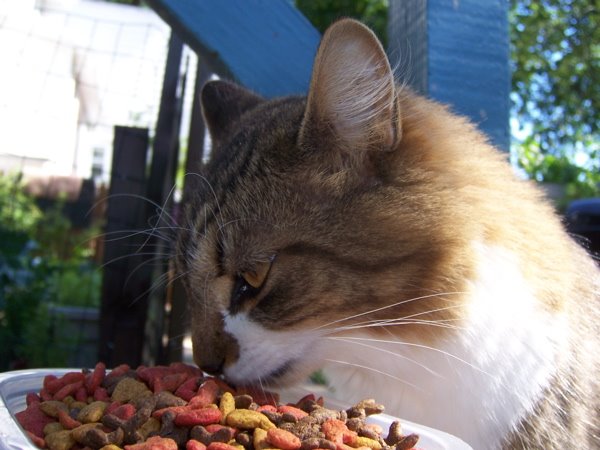
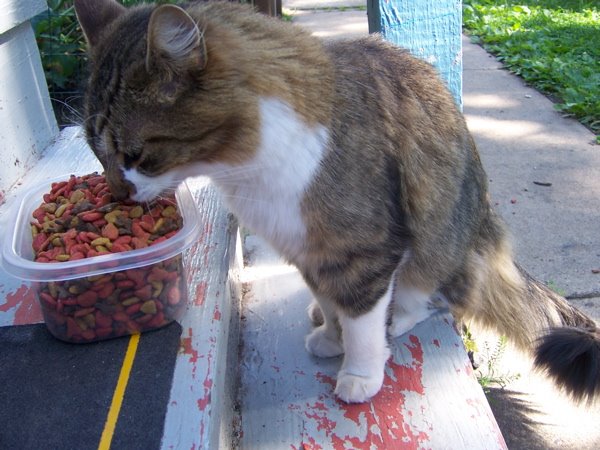
This is one of our stray cat friends. We call him/her “Woym,” like the kid from the Little Rascals. I can’t really explain that, but I can tell you that feral cats avoid contact with people. Some feral cats come to our All You Can Eat Kibble Bar and though we can see them they flee if Pete or I take a step toward them. Woym, on the other hand, seeks physical contact. Woym wants to chat about his/her busy day of being a cat, wants some scritches and a nosh, thank you very much. This means Woym is not a feral cat. Either he/she ran away or was abandoned. I’m working on finding Woym a home because I can’t standing thinking about what winter might be like for abandoned house pets.

This is something I can change. That is an important point to hold on to when much of the world feels deeply unjust, corrupt and profoundly dangerous. I can change some things. Sometimes it is a matter of finding a creative way to do it. We are looking down the barrel of an economy about to blow, which means we are hearing cries for help more often. We cannot ignore them, even as we accept that we have limited time, money and growing compassion fatigue. Arthur Silbers needs your help.

And I’m about to face (again) a choice between food and heart medication. I’ve eaten through almost all the food I had stored up; in the last week, I’ve been forced to eat the contents of a few cans of food that had been pushed to the backs of some kitchen shelves. They were very old; perhaps the recent intestinal unpleasantness was the result of something that shouldn’t have been eaten. But those particular problems have periodically gone on for a long time now, so possibly tainted food can’t be the entire explanation. Eating healthy foods, which would be a good idea given the heart problems, is pretty much beyond my means for good now. Last week, I spent most of a donation from a regular contributor on cat food. (Many thanks to K.R. and to the few others who make donations on a regular basis, as well as to all those who help keep me going.) First things first. It’s one thing for me to fade away, slowly or perhaps more quickly, but I can’t allow the same to happen to my two feline companions. If I were truly responsible, I would try to find them good new homes right now. That undoubtedly has been true for some time. But I admit that I can’t bear to think of life without them. The dilemma haunts me every day.

What can we do for him? If you’re in Los Angeles, can you help him find good homes for his cats? You can. Can you bring him a bag of groceries? You can. Can you help him find an air conditioner on Freecycle? You can. If you have a bar and a band, you can hold a benefit. If you’re outside Los Angeles, you could drop a little dosh into his Paypal account. Got ten bucks burning a hole in your pocket? Five? Three fifty? Please consider donating.

My friend Mary, deeply involved with the concerns of growing girls, forwards a link to Girl Effect. Their website is a little heavy on persuasion and light on statistics, but it reminds one of Kiva. I can’t vouch for Girl Effect, and hope you’ll do your own research, but it’s great to see momentum building worldwide for the improvement of education and economic opportunity.

Woym has sweet chartreuse eyes and soft fur. I have a feeling my co-worker, bruised by the sudden loss of a feline friend, will take Woym in. Serena told me her daughter had a dream about a tabby cat trying to get in. I said, “Far be it from me to separate you from your companion.” The path through despair is love.

A Vacant Lot For Any Spirit To Haunt

Oh brudder:

A passenger told the Italian newspaper Corriere della Sera that she noticed Sicily was missing – while she was on a flight to the island. Smaller islands, such as Sardinia, were in the right place on the map.

Alitalia was re-launched earlier this year under private ownership. It had been a state-run company for more than 60 years before going bankrupt.

One Italian Senator, Riccardo Villari, said it was unfortunate the big advertising campaign surrounding the re-launch had been followed by “unpleasant” errors. The magazine editor, Aldo Canale, said: “We have run lots of editions on the beauty of Sicily and we would never dream of eliminating it from maps of Italy.”

This reminds me of that time on a genealogical bulletin board when someone said my great-grandfather never existed. I recall shouting a lot, “The proof that he lived is that I’M SITTING RIGHT HERE.” See, he married a divorced woman, which was cause for little old ladies to slather White Out all over the family records. Hope Sicily reappears or floating through baggage claim in the Mediterranean’s going to be VERY FREAKING TRICKY.

You’ve got to give it to Chris Dodd. He knows he’s about to fuck up so bad Connecticut’s voters might finally put him out of a job, and yet he sounds so calm about it.

On the one hand, Dodd expressed his strong support for a public health plan that would compete with private insurers and give Americans to buy into an insurance system that doesn’t fatten corporations’ bottom line. On the other, Dodd signaled his willingness to accept a “compromise.”

“We have the votes to pass a bill that expands coverage to millions of Americans, improves quality, protects patient choice, cuts costs, and averts disaster for our economy and our families,” Dodd wrote. “But, as frustrating as it is to you and to me, I don’t know if we have the votes to pass a strong public health care option. What I do know is that whether we can get there or not is still an open question. What I do know is that I plan to fight hard to convince my colleagues on the committee and in the full Senate that we need a public option. What I do know is that I’m going to need your help.”

I’d sound a little more nervous if I were saying to Americans, “Dudes – can I call you ‘Dudes?’ – Dudes, we’re going to expand coverage by forcing you to buy it, refuse to help pay for it and sit around with our collegial thumbs up our asses while the insurers refuse claims and make your lives an exorbitantly expensive living hell.” In fact, knowing that this plan will actually make the lives of Americans much worse would prevent me from saying it at all.

So who knew I had some dignity? Not Siobhan, who just sent an old picture of Ivan and me in Santa suits in a Tewksbury, MA hotel room where she, Ivan and I met up with Johnny and drank Boone’s Farm out of bowls. Apparently, paper cups were illegal within the city limits – but whatever: dignity, motherfuckers! Like the Portuguese, I guess:

Notably, decriminalization has become increasingly popular in Portugal since 2001. Except for some far-right politicians, very few domestic political factions are agitating for a repeal of the 2001 law. And while there is a widespread perception that bureaucratic changes need to be made to Portugal’s decriminalization framework to make it more efficient and effective, there is no real debate about whether drugs should once again be criminalized. More significantly, none of the nightmare scenarios touted by preenactment decriminalization opponents — from rampant increases in drug usage among the young to the transformation of Lisbon into a haven for “drug tourists” — has occurred.

The political consensus in favor of decriminalization is unsurprising in light of the relevant empirical data. Those data indicate that decriminalization has had no adverse effect on drug usage rates in Portugal, which, in numerous categories, are now among the lowest in the EU, particularly when compared with states with stringent criminalization regimes. Although postdecriminalization usage rates have remained roughly the same or even decreased slightly when compared with other EU states, drug-related pathologies — such as sexually transmitted diseases and deaths due to drug usage — have decreased dramatically. Drug policy experts attribute those positive trends to the enhanced ability of the Portuguese government to offer treatment programs to its citizens — enhancements made possible, for numerous reasons, by decriminalization.

You had me at postdecriminalization, Mr. Greenwald.

Running Up That Road, Running Up That Hill

Speechless with horror:

WICHITA, Kan. – Dr. George Tiller, one of the nation’s few providers of late-term abortions despite decades of protests and attacks, was shot and killed Sunday in a church where he was serving as an usher.

The gunman fled, but a 51-year-old suspect was detained some 170 miles away in suburban Kansas City three hours after the shooting, Wichita Deputy Police Chief Tom Stolz said.

Although Stolz refused to release the man’s name, Johnson County sheriff’s spokesman Tom Erickson identified the detained man as Scott Roeder. He has not been charged in the slaying and was expected to be taken to Wichita for questioning.

There was no immediate word of the motive Tiller’s assailant. But the doctor’s violent death was the latest in a string of shootings and bombings over two decades directed against abortion clinics, doctors and staff.

Long a focus of national anti-abortion groups, including a summer-long protest in 1991, Tiller was shot in the foyer of Reformation Lutheran Church, Stolz said. Tiller’s attorney, Dan Monnat, said Tiller’s wife, Jeanne, was in the choir at the time.

I knew this day would come. Everyone did. Even so, he lived every day courageously in a dark and dangerous time. He is truly a hero, most especially to the vulnerable women whose lives he saved.

A Line That Goes Here That Rhymes With Anything

So I’m tooling around FDL and I read this cheery post by Christy Hardin Smith. La la la la Obamas plant a garden at the White House hooray!

The Obamas will plant a garden at the White House, the first since Eleanor Roosevelt’s Victory Garden during WWII. Now that is some change I can fully believe in:

And then I made the mistake of clicking through to the happy article about the happy visit to the White House of some wholesome common sense and I fully expect to see Alice Waters dancing on a table, and I read these words in this order in the motherfucking Washington Post:

President Obama famously learned the political perils of being too familiar with “elite” vegetables such as arugula.

I’d worry more about Obama learning the political perils of being too familiar with “elite” vegetables like Timothy Geithner, who may yet turn out to be a member of the Animal Kingdom. Jesus Donkeypunching Christ, “elite” vegetables? “ELITE” VEGETABLES?

Okay, let’s take this slowly for the They Come Out Of A Can crowd: when seeds and fertilizer love each other in a certain way, in the presence of water and dirt and with sunshine and time, little sprouts turn into bushes, trees and vines that flower and fruit, and – voila! – vegetables ripen, from the lowly potato – though not the potatoe – to majestic corn. Arugula is freaking lettuce. Everyone’s eaten lettuce. Italians everywhere have just decided not to invite the reporter to dinner, fearful of exposing Ms Jane Black to an “elitist” wheat dish called macaroni.

In an unrelated bit of eye-opening hogwash, someone “owns” Colorado’s rainwater, and has for more than 100 years.

But according to the state of Colorado, the rain that falls on [Kris] Holstrom’s property is not hers to keep. It should be allowed to fall to the ground and flow unimpeded into surrounding creeks and streams, the law states, to become the property of farmers, ranchers, developers and water agencies that have bought the rights to those waterways.

What Holstrom does is called rainwater harvesting. It’s a practice that dates back to the dawn of civilization, and is increasingly in vogue among environmentalists and others who pursue sustainable lifestyles. They collect varying amounts of water, depending on the rainfall and the vessels they collect it in. The only risk involved is losing it to evaporation. Or running afoul of Western states’ water laws.

Those laws, some of them more than a century old, have governed the development of the region since pioneer days.

“If you try to collect rainwater, well, that water really belongs to someone else,” said Doug Kemper, executive director of the Colorado Water Congress. “We get into a very detailed accounting on every little drop.”

Frank Jaeger of the Parker Water and Sanitation District, on the arid foothills south of Denver, sees water harvesting as an insidious attempt to take water from entities that have paid dearly for the resource.

“Every drop of water that comes down keeps the ground wet and helps the flow of the river,” Jaeger said. He scoffs at arguments that harvesters like Holstrom only take a few drops from rivers. “Everything always starts with one little bite at a time.”

What what what? What what? An insidious attempt to take water from entities that have paid dearly for the resource – I read that over and over. Stealing water from the sky. Stealing it. From the sky. What in glamorous tarnation is going on in that man’s head?

Organic farmers and urban dreamers aren’t the only people pushing to legalize water harvesting. Developer Harold Smethills wants to build more than 10,000 homes southwest of Denver that would be supplied by giant cisterns that capture the rain that falls on the 3,200-acre subdivision. He supports the change in Colorado law.

“We believe there is something to rainwater harvesting,” Smethills said. “We believe it makes economic sense.”

Collected rainwater is generally considered “gray water,” or water that is not reliably pure enough to drink but can be used to water yards, flush toilets and power heaters. In some states, developers try to include a network of cisterns and catchment pools in every subdivision, but in others, those who catch the rain tend to do so covertly.

In Colorado, rights to bodies of water are held by entities who get preference based on the dates of their claims. Like many other Western states, Colorado has more claims than available water, and even those who hold rights dating back to the late 19th century sometimes find they do not get all of the water they should.

“If I decide to [take rainwater] in 2009, somewhere, maybe 100 miles downstream, there’s a water right that outdates me by 100 years” that’s losing water, said Kevin Rein, assistant state engineer.

State Sen. Chris Romer found out about this facet of state water policy when he built his ecological dream house in Denver, entirely powered by solar energy. He wanted to install a system to catch rainwater, but the state said it couldn’t be permitted.

“It was stunning to me that this common-sense thing couldn’t be done,” said Romer, a Democrat. He sponsored a bill last year to allow water harvesting, but it did not pass.

“Welcome to water politics in Colorado,” Romer said. “You don’t touch my gun, you don’t touch my whiskey, and you don’t touch my water.”

Romer and Republican state Rep. Marsha Looper introduced bills this year to allow harvesting in certain circumstances. Armed with a study that shows that 97% of rainwater that falls on the soil never makes it to streams, they propose to allow harvesting in 11 pilot projects in urban areas, and for rural users like Kris Holstrom whose wells are depleted by drought.

Could Michelle Obama install some rain barrels, too?

Seriously, last weekend, I stood at the customer service counter the Lowe’s on Route 18 in East Brunswick, NJ and explained to five different employees, with various titles on their Hi, I’m ____ name tags, that I would like to be able to walk into their embarrassingly huge garden section and walk out with rain barrels. I need at least four of them, I explained, and to have them shipped to my house would cost as much as a fifth rain barrel. I would prefer, I repeated and repeated, to pay Lowe’s for rain barrels and leave. Not one of them saw there might be some profit to Lowe’s to carry the very specific thing a customer was asking to buy four of. No, really.

Manager: At corporate, they don’t think it’s a good idea to carry something we might sell only once a year.
Tata: Water is expensive. This is a good guard against drought, and you have a lot of small farms around here.
Manager: Maybe you could try our website.
Tata: Did you not hear me explain about the shipping charges? I want to be able to come here, pick out the kind I want, pay you and leave. I want to be able to look at them and see them before they are at my house.
Manager: Some things are just decided at corporate.
Tata: Well, they decided wrongly.

I feel kind of silly hoping simple, obvious things can go right.