Friday Cat Blogging: Full Of Jelly Jars Edition

A couple of months ago on a sunny Saturday, I worked at the family gift shop while my stepdad Tom manned the till at the toy store. During a fabulous dull stretch, we basked in the sun and chatted about biodegradable diapers. Tom is a biologist and up on the news. Tom said there have been recent studies of landfills where drilling down into a pile brought up decades-old pieces of carrot, still orange and carroty and not at all biodegraded because landfill isn’t composting, it’s storage. I’ve mulled this over at great length, and happen to be sitting at the World’s Largest Encyclopedia. Let’s ask it if stuff biodegrades in landfills.

Atticus surveys the 99 steps down to the Great Lake Darla lives above in her new home in Canada.

Organic substances “biodegrade” when they are broken down by other living organisms (such as enzymes and microbes) into their constituent parts, and in turn recycled by nature as the building blocks for new life. The process can occur aerobically (with the aid of oxygen) or anaerobically (without oxygen). Substances break down much faster under aerobic conditions, as oxygen helps break the molecules apart.

Landfills Too Tightly Packed for Most Trash to Biodegrade
Most landfills are fundamentally anaerobic because they are compacted so tightly, and thus do not let much air in. As such, any biodegradation that does take place does so very slowly.

“Typically in landfills, there’s not much dirt, very little oxygen, and few if any microorganisms,” says green consumer advocate and author Debra Lynn Dadd. She cites a landfill study conducted by University of Arizona researchers that uncovered still-recognizable 25-year-old hot dogs, corncobs and grapes in landfills, as well as 50-year-old newspapers that were still readable.

Well. That is shitty news, but it’s not really news, which is one reason we always had a compost pile when I lived at Mom’s house. Look, I was a commune kid. The gas crisis of the seventies for me conjures images of Mom sitting in gas lines, crying. I shut off lights, turn off water, and I am acutely aware of the ugly mess o’ compostibles I’m not composting, but while I live in an apartment, what can I do? Wa$ted, an eco game show from New Zealand combining cold cash and hot schadenfreude, introduced – to me, at least – the notion of worm farming. This seems like a great idea for someone.

Atticus descends the stairs to the forest. I wonder if he remembers sleeping on my head.

Some folks sort the worms out of the castings and put the worms in fresh bedding. We have other things to do with our time and prefer a split harvest method. It helps if you have trained your worms ahead of time for this harvest method. To train your worms, you start feeding them at only one end of the bin. Do this for about a week. (Worms learn pretty fast.) Now take the bedding/castings out of the end of the farm where you were not feeding them and add it to your plants or garden. You will be removing about half to two thirds of the bedding/castings in this step. You will lose some worms, but those were the ones that were not very smart. Remember you trained the others.

Flying Spaghetti Monster! Train worms? I can’t join that chicken outfit! – though, apparently worm training is hilarious. Back to shopping for another composting method. This shows promise, though it uses electricity:

Darla says Atticus roams far and wide and has introduced himself to the neighbors, Step 1 in his plan to hold some municipal office.

How it works: Deposit food waste items at any time, on any day. Add up to 120 lbs (55kg) per month. For best results, cut items into small pieces. Items remain in the upper chamber, with “hot composting” conditions: mixing, air flow, heat, and moisture (see diagram). The energy released destroys odors, pathogens, and seed germination. The compost is later transferred through a trap door to the lower cure tray chamber, where it continues to compost while you add fresh waste items to the upper chamber.

Interesting…interesting. I do wonder what someone who lives in a little home on the hundredth floor does with resulting buckets of nitrogen-rich soil, though I could march outside and dump compost into the complex’s flower beds. It’s a step in some right direction, but shall we dance?

Luck Sees Us the Same

A zillion years ago, a man looked at his datebook, struggled with English and asked, “What’s Jesus Flying Day?”

Jesus may fly but Mark Hollis is a god. This song, which I love with my whole tattered black heart, sounds to me like Judas sitting on a wooden chair at the window, staring at the bleak wintry countryside, asking himself what happened – unless it’s Jesus, and oh boy.

Unlock the Secret Voice

My co-worker has been unloading spare plants. Yesterday, I turned the corner and my cubicle was full of hostas in a giant black trash bag.

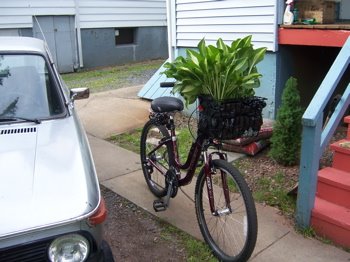
If you’re asking yourself, “Hey Ta, did Topaz and Drusy leap and gambol about the plants in your living room, did you in fact pedal your bicycle from your place to Pete’s with those hostas in the basket, and did I hear you cackling from the other side of the Turnpike?” then the answers are yes, yes and yes, and if you didn’t know, a giant bag of plant life is freaking heavy.

In Pete’s front yard, we find two scrabbly patches busily eroding under the tall trees that line the avenue. Rumor has it hostas spread and take over, which wouldn’t be the worst thing that could happen to a scrabbly patch in full shade. My cubicle survived a narrow escape.

Are My Hands Clean?

Voice of America News:

The estimates of the number of Chinese people still in prison for their activities in 1989 range from 50 to 200.

John Kamm, whose San Francisco-based Dui Hua Foundation tracks political prisoners in China, says the list of so-called June 4 prisoners includes people all over the country.

“There’s a fellow called Liu Zhihua, in Hunan,” said . He’s the last of a group of workers that organized one of the largest worker strikes in 1989, at the Xiangtan Electrical Machinery Factory. Leader Chen Gang, everyone else, has been released. He’s still in. There’s a peasant in Guizhou, by the name of Hu Xinghua, Miao nationality, set up something called the Chinese People’s Solidarity Party. He’s still in.”

Kamm’s organization and other human rights groups are calling on the Chinese government to release people put in jail for their 1989 activities, as a goodwill gesture before the Beijing Olympics in August.

“China, if you want to do something to improve your image, how about setting free the remaining June 4 prisoners, putting June 4 behind you?” he said.

The Guardian:

The United States is operating “floating prisons” to house those arrested in its war on terror, according to human rights lawyers, who claim there has been an attempt to conceal the numbers and whereabouts of detainees.

Details of ships where detainees have been held and sites allegedly being used in countries across the world have been compiled as the debate over detention without trial intensifies on both sides of the Atlantic. The US government was yesterday urged to list the names and whereabouts of all those detained.

Information about the operation of prison ships has emerged through a number of sources, including statements from the US military, the Council of Europe and related parliamentary bodies, and the testimonies of prisoners.

– snip! –

According to research carried out by Reprieve, the US may have used as many as 17 ships as “floating prisons” since 2001. Detainees are interrogated aboard the vessels and then rendered to other, often undisclosed, locations, it is claimed.

– snip! –

The Reprieve study includes the account of a prisoner released from Guantánamo Bay, who described a fellow inmate’s story of detention on an amphibious assault ship. “One of my fellow prisoners in Guantánamo was at sea on an American ship with about 50 others before coming to Guantánamo … he was in the cage next to me. He told me that there were about 50 other people on the ship. They were all closed off in the bottom of the ship. The prisoner commented to me that it was like something you see on TV. The people held on the ship were beaten even more severely than in Guantánamo.”

Clive Stafford Smith, Reprieve’s legal director, said: “They choose ships to try to keep their misconduct as far as possible from the prying eyes of the media and lawyers. We will eventually reunite these ghost prisoners with their legal rights.

“By its own admission, the US government is currently detaining at least 26,000 people without trial in secret prisons, and information suggests up to 80,000 have been ‘through the system’ since 2001. The US government must show a commitment to rights and basic humanity by immediately revealing who these people are, where they are, and what has been done to them.”

Twenty-six thousand.

Crossposted at Blanton’s and Ashton’s.

Around Your Old Address

Poets have been mysteriously silent on the subject of cheese.
— G. K. Chesterton

When one spends a great deal of time with a chef one doesn’t so much lose one’s waistline as develop a circumference. I am eager to get moving. Thus, last weekend, Pete and I conquered household tasks at his place together and separately, and with vigor. I went out and worked on the garden, which was reassuring. While I had my hands in dirt I was in no way making and eating exotic sandwiches. This reminds me: jazz, Georg and I and a dozen or so of our friends used to go camping and during the few hours between I Meant To Do That and When Does the Bar Open?, we played a glamorous game called I Am A Sandwich. It was like Twenty Questions, except with lettuce and tomatoes, and everyone’s goal was to get over on the group with some obscure cheesy goodness. Speaking of tomatoes, I staked up the tomato plants with bamboo poles and zip ties, in anticipation of the day when fresh mozzarella and basil solve the problem of pomodoro prosperity.

One of my least favorite tasks is transplanting and tying up the bean plants. Pete had sowed the seeds generously, so I had to spread out my little hostages and wrapped a bit of cotton string around each. I tied the other end to a line stretching across each row. Beanstalks, as every child knows, climb to the firmament, though most stop after about three feet and seldom cost a cow. I transplanted my fingers to the bone but I only tied up about one-third of my leafy captives before moving on to other tasks like mulching, food prep and plotting the cocktail hour. You get just one 5 p.m. each day, and gin isn’t going to drink itself!

Yesterday was the anniversary of Steve Gilliard’s passing, and at the Group News Blog, you will find heartfelt laments. I can’t add to that, and if I could, what would it bring into being? At lunchtime, I drove to Home Depot in glorious sunshine, bought four bags of shredded pine bark and after work, put down mulch with Gilly in mind. I used to go dancing when someone died because grief needs a place to go and we can’t let it settle or it stays. Likewise, the house we care for now was the place Pete’s family moved when his mother died, and grief settled in. Painting, gardening, sewing seeds and making repairs in anticipation of life celebrates what we had and what we will. So for Gilly, I put pine bark around a bed of decorative and fruit trees. In ways we are still learning, he was so very wise.

Boys In Bikinis, Girls On Surfboards

A few weeks ago, I started hearing a song in my head I didn’t recognize, and didn’t know where I’d heard it. With rings on my fingers and bells on my toes, I shall have music wherever the hell, and for a person who goes nowhere, I sure do get around. On Friday, I realized it was playing on Altrok Radio, so I called up Sean and said, “This is your demographic speaking. What is the name of this song?”

Sean said, “Sing it for me.”

I said, “It doesn’t have words I can hear but it’s like a Beach Boys song played by Peter Gabriel’s band after an exceptional night with hot- and cold-running vodka.”

It’s Yeasayer and 2080. This video made by a fan is a patient and lovely rendering of the piece. YouTube has a live studio version – which I would usually prefer – but I hear the singer’s nerves.

I like it even better now that I recognize lyrics.