Through Our Anecdotic Revue

Sweet Kali, why why why?

President Obama this week:

Americans can help by continuing to visit the communities and beaches of the Gulf Coast. I was talking to the governors just a couple of days ago, and they wanted me to remind everybody that except for three beaches in Louisiana, all of the Gulf’s beaches are open. They are safe and they are clean.

Christ on a cracker, everyone knows what happens when an authority figure says The beaches are safe! it’s time to make a break for the mountains: Greek tragedy-grade comeuppance is on its way. Canst thou catch Leviathan or a scriptwriter with a hook?

Things That They Say Honor Bright

This volcano is raining ash on my Guatemalan cousins.  My cousin says ash is raining on houses and cars in Guatemala. The photographs of the eruption are elegant compositions depicting a frightening local reality. This one is my favorite. It reminds me of the reasons my great-grandparents left Sicily: Nothing there but rocks, they said. Of course, it wasn’t true. Sicily, like Guatemala, is by all accounts a lush, lovely place.

Rumor has it the reporter who was killed was standing next to the lava like this guy.

On the other hand, sometimes you could take a hint and a powder. My cousin, a tender hearted young mommy with bright, talented children, who speaks four languages and has traveled extensively, curtly remarked that reporters are supposed to be close to the story, but really. I was impressed with her pragmatism, seeing as how I have an irrational fear of lava that’s looking less and less irrational as Guatemalan children go missing. Perhaps my cousins would like to sojourn in torpid New Jersey.

A Mouthful of Red Kryptonite

This lilac is trying to tell you something.

The choir has been part of our lives for over a decade, maybe closer to two. Tom and his college glee club friends joined ages ago to sing for a director they liked. Tom is a large man, but he sings in a high, clear tenor that could break your heart. Mom joined after a few years’ voice lessons, though she developed the confidence some time later to become the choir’s president and grant writer. The choir took them across Europe and to the Vatican and tonight to St. Thomas the Apostle Church in Old Bridge, NJ, where in an auditorium the choir is singing and in the next room, a boozy high school reunion makes liberal use of a PA system. Someone in scheduling has really fucked up.

This lilac ha got your number!

After the choir completed Foss’ Behold! I Build An House, reunion celebrants began filing through a side door in the lobby to use restrooms. I sat in the lobby, directing. Periodically, and I mean that in its rhythmic sense, revelers fell through the door, shouting. I shushed them, speaking quietly myself. A monsignor and two women stood right next to me, gibbering loudly about the locked sacristy door. I asked them to please speak quietly. The monsignor asked why he should whisper. I said, “Choir concert,” and pointed to the auditorium behind him. He whined loudly, “I told them this door should be left unlocked for me.” One of the women produced a key just as I was considering how loudly he’d whine if I dragged him out the front doors, so I’m not under arrest. During Pärt’s Berliner Messe, the trickle of peeing partiers steadily grew to a stream, and fewer of them cared whether they were disturbing anyone else. At intermission, Pete reappeared and we decided to hand over the t-shirt concession to one of the young ushers and leave the lobby without a bouncer for Faure’s Requiem.

Mom really wanted us to help out tonight. Chances seem excellent tomorrow she will be singing a different tune.

Noise I Think It’s Pretty

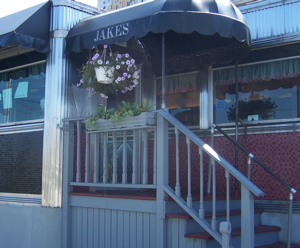
A diner so tiny the Blue Plate is a monkey dish.

It’s been cold and dreary for the best part of a week and I may be in a snit about it. It’s May. I should be outdoors with wind rushing through my hair like a piquant shampoo commercial, but no. I’m huddled under a blanket in my living room, waiting for Nature to quit acting like a motherfucker. Further, it’s springtime and people are making plans. Auntie InExcelsisDeo and I had this annual conversation.

Auntie I.: There’ll be a bridal shower.
Tata: I’m not going.
Auntie I.: You’re going. It’ll be a barbecue and later there’ll be a band.
Tata: I’m not going.
Auntie I.: You’re going. It’ll be nice, and it won’t be girly.
Tata: I’ll mail cash from a great distance. But I’m not going.
Auntie I.: You’re going!

I’m not going. The happy couple are already married, which marriage happened in the office of a Justice of the Peace when my first cousin was deployed to Iraq, but now they want the big honking wedding. He’s not afflicted with deep thoughts or sobriety; she’s a lovely biker chick. Their friends are the kind of racist lunkheads I cross the street to avoid. It’s not all about me, but I try to do something constructive with my rage. With any luck, I can find a soup kitchen in need of a spice organizer and, on the day of the renewed nuptials, I’ll be up to my elbows in garam masala.

If This Land’s Still Made

How big a fucking bottle of Dawn will it take to wash away “an event of national significance?”

Answer: a bottle the size of Australia.

Here’s what’s being done to capture the oil:

Chemical dispersants: About 100,000 gallons of chemical dispersant has been dropped from the air into the Gulf, where it breaks up the oil slick into smaller droplets. The droplets then get mixed into the water, where they are subjected to ocean currents and natural degradation processes, according to the Minerals Management Service (MMS). “This potentially exposes the water column and near shore shallow bottom-dwelling organisms to oil,” according to MMS.
Soapy soap soap.

Skimmers: Once broken up, skimming vessels come in and collect what’s left. The droplets are collected in drums and some of that material gets cleaned and recycled. The rest is “properly disposed,” Mendenhall said. But skimmers can only capture about 10 percent of the volume of spilled oil, according to Charlie Henry of the National Oceanic and Atmospheric Administration (NOAA).

Controlled burn: On Wednesday, BP and the Coast Guard, along with other agencies, conducted an in-situ burn in which they used a fireproof boom to corral dense parts of the oil spill, moving it to another location and then burning it.

Soapy!

In general, burning is probably the most effective method for cleaning up heavy oil like that leaking in the Gulf, according to said Edward Overton, a professor emeritus of environmental sciences at Louisiana State University. But it has drawbacks. When you burn near the coast, you have to destroy wildlife, and offshore burning is harder to do.

“I have no idea what we’re going to do, this is trial and error to see what works and what doesn’t work,” Overton said. And news reports suggest since the oil is really an oil-water mix, burning actually might not do the trick.

Collection domes: BP has also started to put together a subsea oil collection system, and when used will be the first time this shallow-water technology has been adapted for the deep water. The oil leaks in the Gulf are nearly a mile down. It is expected to be ready for deployment within the next four weeks, according to BP.

When ready, here’s how the oil-spill technology would work: The dome would be placed on the seabed to capture the leaking oil. This oil would then be pumped up to surface vessels that could collect the oil and take it away. Similar systems have been used in shallow water, but never at depth of 5,000 feet. The Coast Guard has said the construction could take two to four weeks.

New method: However, Thursday afternoon officials said they might try an experimental oil-dispersal method that would involve releasing chemicals from under the water. “We were notified that this technique might be more effective in spreading the dispersant at the source on the riser than by using aircraft to spread it on the sea,” said Doug Suttles, BP’s Chief Operating Officer.

Soap

Leftover oil

As for what happens to the “dispersed oil,” that doesn’t get skimmed off or burned off or otherwise collected, “We’re told it disperses naturally. It eventually breaks up and evaporates. There are different ways, but we’re told it just kind of goes away,” U.S. Coast Guard’s Mendenhall said.

Bacteria can also help degrade most components of oil.

Soapy soap.

But not all oils are created equally. At first, reports suggested the oil leaking into the Gulf was standard Louisiana crude oil, a type of oil that biodegrades pretty well, Overton said. But sample testing revealed that the leaking oil was a different type, one that contains a very high concentration of components that don’t degrade easily, called asphaltenes, according to Overton. He estimates that the concentration of these asphaltic components could be as high as 50 percent in this oil spill, while in other types of crude oil it might be as low as 1 or 2 percent.

“That is bad, bad news, because this oil is going to be very slow to degrade,” Overton said today.

Soapy soapy soap soap soap.

Some of the oil sinks to the sea bottom, where it can get buried into an anaerobic zone where there’s no oxygen. Oil in these zones stays in a chemically reduced form and doesn’t degrade as much, Overton said. But, he added, there’s not much life down there to be contaminated.

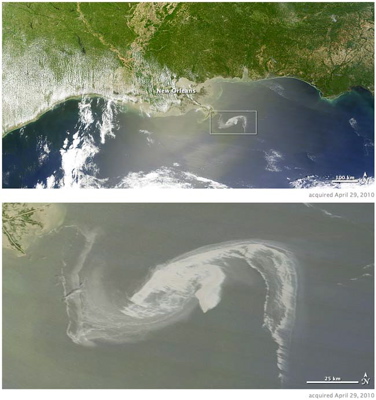
The oil slick could reach the Mississippi Delta coast as early as Friday, so at least some oil will hit shore. A satellite image of the slick taken Thursday showed it was almost touching the delta.

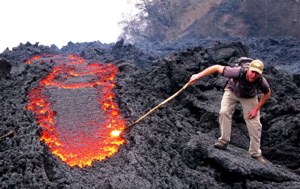
Image: NASA/Terra