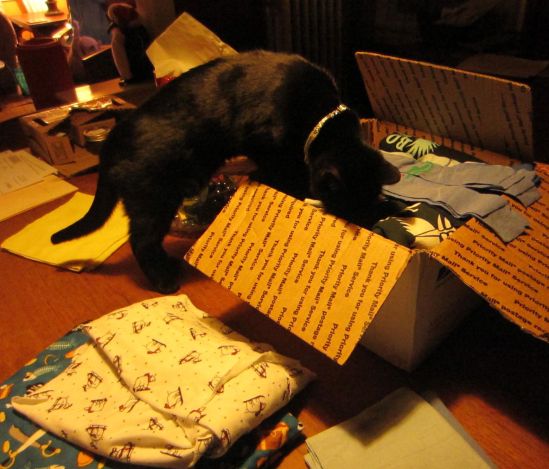
Reason #7,592 to love the Post Office: friends send art supplies for your project that also entertain your Furry Overlords.
For a couple of days last week, my friends yapped about this article at Cracked.com: Six Harsh Truths That Will Make You A Better Person. It is written in an antagonistic manner intended to incite fatass whiners to get off their asses and fatten up their skill set and every person in comments who raves about the message has already gotten it. I doubt the intended recipients of that message appreciate it, but I appreciated this:
Saying that you’re a nice guy is like a restaurant whose only selling point is that the food doesn’t make you sick. You’re like a new movie whose title is This Movie Is in English, and its tagline is “The actors are clearly visible.”
I was just about to quit reading when that line caused me to give the article, which had twice cited an odious scene from Glengarry Glen Ross I have no interest in reliving, a second chance. The point eventually becomes: learn things, practice new skills, change to be what you want to be and do what you want to do, but it’s aimed at people who are doing nothing but aging. Yikes.
This method of assessing a situation works for me:
I ask myself this question almost every day: what are my assets? What am I? What do I have? What can I do? What do I want? Sometimes, I don’t have answers. If I am very lucky, I have new and surprising answers. Those are the best days.
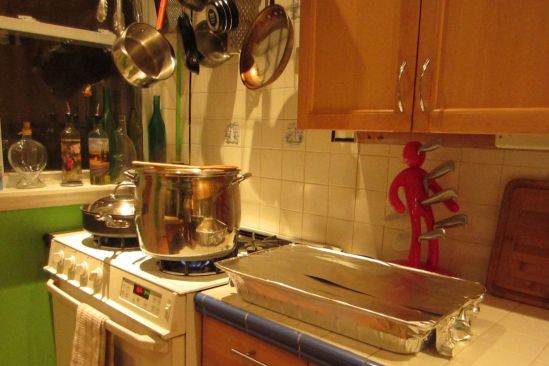
As a direct result of watching America’s Test Kitchen last night, my husband is making homemade tater tots right now and they are DELICIOUS. Is a tote bag in my future?
This year, thanks to yarn donors, we’re sending three to the hospital’s baby blanket project. Many thanks to you and you and you and you. You, too.
I’ve figured out a few things about these winter projects.
1. Start in the spring.
2. It seems stupid, but knit when it’s 90 degrees on the porch.
3. Don’t stop.
Miss Sasha has been making hats on a knitting loom. I have been hmm-hmm-hmm-ing about whether or not I could turn out hats this way, but I’d have to have a place to send them. It must be noted that I am in New Jersey and even toddlers get mouthy when you stroke their hair.
The horror of a massacre of first graders and their teachers – children and women – was immediately compounded by the loud and persistent call by an apparently endless parade of crazed white men for more guns in schools. Before the bodies had even been removed from the school, white men slammed teachers and unions for the wholesale killing, blamed contraception, blamed everyone but gun culture and mental illness. Columbine was thirteen years ago and I was no longer interested in school shootings because Americans were playing them on TV as spectacles and I wasn’t playing along; but this latest crime brought us a secondary horror. One would think that when women and children lay in pools of blood, men, ultimately our partners in the enterprise of living, would lay down their arms to take us in theirs. Instead, all across the electronically connected United States, white men have chosen to hang on to their guns.
This is not just a gun problem. This is not just a mental illness problem. This is also a profound disconnection of white men from women and children, one I still can’t really believe I’m seeing. It’s shocking and, somewhere in my gut, something has changed. I now wonder if women and children should have safe towns or even states where men are not allowed, and if that is the only way we can live in relative peace and safety.
Cooking Sunday dinner for the volunteers working at the Shore. Today, I heard a rumor that to fully restore the Shore towns may take seven years and we might be making dinners for years to come.
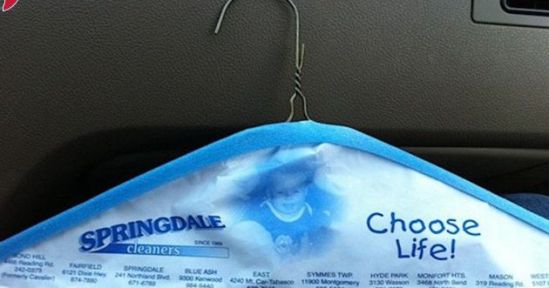
“I think it’s the perfect place to advertise a pro-life message,” Springdale Cleaners owner Paul Dehler told HuffPost. The 66-year-old said he printed the images on the hangers to support his sister, who’s opposed to women’s right to choose an abortion.
“I don’t get into all that,” Dehler said of the abortion debate. “I’m just putting the message out there, and doing it for my sister.”
Pro-choice advocates in the U.S. have historically used coat hangers as symbols to illustrate the dangers of outlawing abortions, suggesting that women would use such rudimentary tools to end pregnancies if the state barred medical personnel from performing abortions. But Dehler, who has run Springdale since it opened in 1969, said his hangers are aimed at promoting a pro-life stance.
Springdale Cleaners first started producing its pro-life hangers six years ago, when Dehler’s granddaughter was an infant, he explained. “Some customers have said they don’t like the hangers, and in some cases I’ve lost their business,” Dehler said. “But I’d like to think that I’ve gained more customers with these hangers than I’ve lost.”
That cites a New York Times article you should read in its unforgiving entirety written by a retired gynecologist, but this is salient:
My early formal training in my specialty was spent in New York City, from 1948 to 1953, in two of the city’s large municipal hospitals.
There I saw and treated almost every complication of illegal abortion that one could conjure, done either by the patient herself or by an abortionist — often unknowing, unskilled and probably uncaring. Yet the patient never told us who did the work, or where and under what conditions it was performed. She was in dire need of our help to complete the process or, as frequently was the case, to correct what damage might have been done.
The patient also did not explain why she had attempted the abortion, and we did not ask. This was a decision she made for herself, and the reasons were hers alone. Yet this much was clear: The woman had put herself at total risk, and literally did not know whether she would live or die.
This, too, was clear: Her desperate need to terminate a pregnancy was the driving force behind the selection of any method available.
The familiar symbol of illegal abortion is the infamous “coat hanger” — which may be the symbol, but is in no way a myth. In my years in New York, several women arrived with a hanger still in place. Whoever put it in — perhaps the patient herself — found it trapped in the cervix and could not remove it.
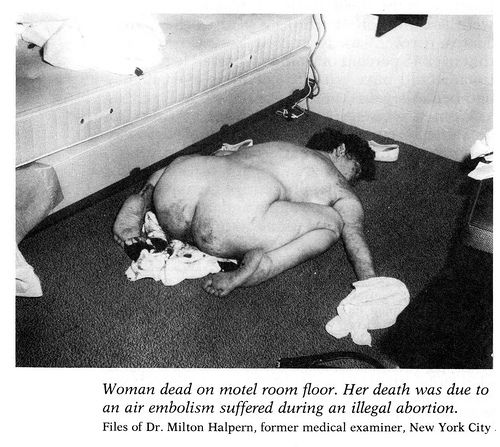
That’s what coat hangers meant. This is what coat hangers meant:
Gerri Santoro was a real woman with real problems and no way out.
Paul Dehler is a stupid man who should keep his opinions about ladybusiness to himself.
On Tuesday, my office cellmate and I went out for a walk down College Avenue at lunchtime. People were rushing in every direction and the sunlight felt pretty good in the warm afternoon. At the corner of Bishop and College, Sigma Delta Tau often holds bake sales for vague causes. “Buy this cookie to prevent child abuse,” is a common refrain. Tuesday, the sorority sisters were running around on the grass, where plastic-wrapped pallets sat on the sharply sloping lawn like odd spines on a stegosaurus. A herd of lanky frat boys lugged another plastic-wrapped pallet up the hill to a spot near the building. Everyone was laughing in the oddly warm December sun. The frat boys scrambled down the hill and in front of us bounced as one body toward a strangely placed 18-wheeler. My cellmate and I walked on, but my back hurt, so at the corner of Hamilton, we turned back.
This time, we could see the truck was nearly empty but the boys were unloading another pallet. It looked heavy. We could see from this angle the pallets were Jingos, some new thing Pepperidge Farms is selling with shouty commercials. Yeah, that one. About twenty pallets dotted the sloping, uneven lawn. It looked like the back of a giant, plastic-wrapped stegosaurus, but in a minute, we had forgotten all about it.
An hour later, my phone rang. A guy who ran an office one floor up wanted to know what a sorority should do with a sudden and shocking abundance of snack crackers after a verbal miscommunication with Pepperidge Farms. I started listing off agencies. The guy was keeping an awesome story to himself, I could tell. I did not want to miss out on whatever it was, so I hung up on him and ran upstairs.
In his office, I found him red-faced and laughing, sitting with a young woman I didn’t know. It developed that she was a member of the lawn snack sorority, which by the way appears to be called EAT at first glance, and some other sorority girl had had a conversation with some PR lackey that might’ve sounded like:
PR dude: Would you mind passing out some of our new snack crackers?
Sorority girl: We – like – would not mind.
And then a truck showed up. The sorority now wanted to know who would accept a donation of thousands of snack-size bags of Jingos because the sage at the local soup kitchen donation line wasn’t answering his phone. Fortunately for the sorority, we just had a hurricane and thousands of people were living in shelters, so I made a list of agencies looking for donations, though I should have mentioned that, not for nothing, there’s a grammar school two blocks away and you know all of those children don’t eat every day. But that slipped my mind. They asked if I wanted some. Thinking of the anti-hunger project, I said sure. The young woman asked how many cases because she brought cases of Jingos with her when she came to work. I said I’d take three for our three families. She disappeared and returned with three cases and a single serving bag, which I gave to one of my co-workers who still has a metabolism and normal blood pressure. Remember how those pallets required a herd of sweaty frat boys? Those boys were pretending to struggle because three cases weighed nothing.
A little while later, I called my sister to tell her a sorority on College Avenue was frantically trying to unload cases of crackers. She said maybe the church could send a car, but how would the driver find the right place? I told her to look for the only building on College Avenue that looked anxious about retaining water, and this was a matter of some urgency because Tuesday night it was going to rain.
Pete drove me to work Wednesday morning. We were gratified to see about half the number of pallets I’d seen were now propped neatly against the building and no food was mildewing on the lawn. From this, I learned that I need more twenty year olds to make cargo-size food errors.




 Poor Impulse Control